A plain-language primer
How the Internet Actually Works
There is no cloud. There is no magic. There are wires, addresses, and a very large number of extremely fast mail sorters. Here is the whole thing, from the top, with nothing you need to look up.
What’s inside
- The one-paragraph version
- What a network really is
- Everything needs an address
- Your message gets chopped into pieces
- Routers: the world’s fastest mail sorters
- Names instead of numbers (DNS)
- Who asks, who answers
- The stack of jobs (layers)
- The Web is not the internet
- The actual physical stuff
- The Canadian chapter
- Padlocks, privacy and staying safe
- Who owns the internet? (Nobody)
- What it costs the planet
- The whole journey, start to finish
- What happens next, connecting everyone
- AI is changing what the internet is for
- Who gets to control it
- Proving things are real
- Telling true from false
- Words you now know
- Sources
Eight words before you start
Every one of these gets explained properly later. Reading them now means your brain isn’t learning the word and the idea at the same time, which is the whole reason this box exists.
- Network
- Any group of computers connected so they can pass messages.
- Protocol
- An agreed set of rules. That’s all. Not a machine.
- Packet
- A small numbered piece of a bigger message.
- IP address
- A machine’s number, like a street address.
- Router
- A machine that reads a packet’s address and passes it one step closer.
- DNS
- The phone book that turns names into numbers.
- Server
- A computer left switched on, waiting to answer questions.
- Encryption
- Scrambling a message so only the right person can read it.
How to read this primer: there’s a Check yourself box at the end of each part. Use them. Answering from memory is what makes things stick; rereading feels more effective and isn’t. There are also marked stopping points; 20 parts is not one sitting.
Part 1The one-paragraph version
The internet is a huge pile of computers connected by wires, radio signals and light, all of which have agreed to follow the same set of rules for passing messages along.
That’s it. That’s the whole idea. Everything else in this primer is a detail hanging off that sentence.
The reason it feels like magic is that the details happen very fast and completely out of sight. When you tap a video, roughly ten different systems do their jobs in about a quarter of a second, and none of them show their work. So the rest of this is really just that hidden part, written out slowly enough to follow.
About 6 billion people, around 74% of everyone alive, used the internet in 2025. About 2.2 billion people still don’t have it at all.[1] So it is big, but it is not everywhere, and it is not everyone.
Part 2What a network really is
Take two tin cans and a piece of string. Pull the string tight, talk into one can, and your friend hears you out of the other. Congratulations, you built a network. It has two members and one wire.
Now imagine you all want to talk to each other, not just to you. You and three friends need six strings. You and four friends need ten. You and a hundred friends need 5,050. By the time you get to a whole city, you’d need more string than there is string.
So nobody does that. Instead, everybody runs one wire to a shared box in the middle, and that box passes messages along. The box is the thing that makes big networks possible.

Your home has one of these boxes. It’s the thing with blinking lights, and it does two jobs: it’s a switch or router that connects your devices to each other, and it’s the doorway out to everything else.
Now here’s the leap. The internet is what you get when you connect the boxes to each other. Your house’s box connects to your neighbourhood’s box, which connects to your city’s box, which connects to a really big box in a building downtown, which connects by cable to a box in another country. Networks of networks of networks. The word “internet” literally means “between networks.”
The key idea
Nobody built the internet as one machine. Thousands of separate networks (companies, universities, phone providers, governments) each built their own piece and agreed to plug into each other. It works because they all follow the same rules, not because anyone is in charge.
Check yourself, Part 2
Try to answer before you look. Recalling it is what makes it stick; rereading only feels like it does.
1. Six computers all want to talk to each other. Why doesn’t each one just run a wire to every other one?
Answer
Because the wires explode in number, six computers would need fifteen. A hundred friends would need 5,050. One shared box in the middle means one wire each.
2. What does the word “internet” literally mean?
Answer
“Between networks.” It’s networks of networks — your house’s box to your neighbourhood’s, to your city’s, to another country’s.
3. Nobody is in charge of the internet. So why does it work at all?
Answer
Because everyone agreed to follow the same rules. Not ownership, agreement. Sandford Fleming got the world to agree what time it is the same way.
Part 3Everything needs an address
Imagine mailing a letter with no address on the envelope. The post office would have no idea what to do with it. Same problem here: if a message is going to travel across the world, every machine along the way needs to know where it’s headed.
So every device on the internet gets an IP address. IP stands for Internet Protocol, and “protocol” is just a fancy word for “the agreed rules.” An IP address looks like this:
142.250.190.78Four numbers, each between 0 and 255, separated by dots. That’s the old style, called IPv4, and it allows about 4.3 billion different addresses.[2]
Four billion sounds like plenty. It wasn’t. There are more than 4.3 billion phones, laptops, TVs, watches, doorbells and fridges wanting addresses, and the world officially ran short years ago.[2]
So there’s a newer style, IPv6, which looks like this:
2607:f8b0:400b:80c::200eStop and thinkBefore you read on, why would anyone bother inventing a whole new address format, instead of just being cleverer about reusing the old ones? (Both actually happened. Only one of them keeps working forever.)
Uglier, but it allows about 340 trillion trillion trillion addresses.[2] That is enough to give an address to every grain of sand on Earth and still have almost all of them left over, so this is not a shortage anyone expects to run into again.
Think of it like
An IP address is a street address for a machine. It says where, not who. If you move your laptop from home to a café, your laptop gets a different IP address, the same way you’d have a different address if you moved house. This is also why an IP address is a clue about your location, but a rough one.
Check yourself, Part 3
Try to answer before you look. Recalling it is what makes it stick; rereading only feels like it does.
1. An IP address tells you where or who?
Answer
Where. It’s a street address for a machine, not an identity. Move your laptop to a café and it gets a different one, which is why an IP address is only a rough clue about location.
2. IPv4 gives about 4.3 billion addresses and the world ran short years ago. Why didn’t that turn into a crisis?
Answer
People found workarounds, mostly many devices sharing one address, and started moving to IPv6. The price of an IPv4 address actually fell. The shortage was real; the crisis wasn’t.
Part 4Your message gets chopped into pieces
Here’s the single cleverest idea in the whole system, and it’s a bit surprising the first time you hear it.
When you send something (a photo, a message, one second of a video) it does not travel as one lump. It gets sliced into hundreds or thousands of small pieces called packets. Each packet gets a little label on the front saying where it came from, where it’s going, and which piece number it is.
Then the packets are released into the network. Here’s the strange bit: nothing requires them to take the same route. Each one is handled independently, so they can go different ways and arrive out of order. The computer at the other end reads the piece numbers, puts them back in order, and reassembles your photo.
In practice, modern networks usually try to keep one conversation on one path, because that’s a bit faster. But they don’t have to, and when a cable breaks mid-download, that freedom is what saves you.

Why do it this way? Three reasons, and they’re all good ones.
- Sharing. If messages travelled as one lump, one person downloading a movie would block the wire for everyone else. Small packets take turns, so everyone gets a slice.
- Survival. If a cable gets cut or a machine crashes, the packets just go around the damage. No single broken piece takes down the whole thing.
- Repair. If packet 47 goes missing, your computer notices the gap and asks for just that one piece again, not the whole photo.
Think of it like
You want to send a friend a 500-page book, but the postal service only accepts postcards. So you copy one page onto each postcard, number them 1 to 500, and drop them all in the mailbox. They arrive over three days in a completely random order. Your friend sorts them by number, and there’s the book. Now imagine the sorting happens in a few thousandths of a second.
A myth worth correcting
You will often hear that the internet was built to survive a nuclear war. That’s close to true, but not quite. The idea of splitting messages into pieces that route around damage came from Paul Baran at the RAND Corporation in the early 1960s, and survivability really was his motivation. But ARPANET, the network that got built, was made mostly so researchers could share a handful of very expensive computers. Several of the people who built it have said flatly that the nuclear story is not why they did it.
Check yourself, Part 4
Try to answer before you look. Recalling it is what makes it stick; rereading only feels like it does.
1. Your photo is cut into hundreds of packets, and each one gets a number. Why the number?
Answer
Because packets can arrive out of order. The numbers let the far end reassemble them correctly, and spot that packet 47 is missing so it can ask for just that one again.
2. A cable gets cut halfway through your download. Why doesn’t the download simply die?
Answer
Each packet is handled independently, so the ones still coming can go around the damage. No single broken piece takes down the whole thing.
3. Was packet switching invented to survive a nuclear war? Careful with this one.
Answer
Not quite. Survivability motivated Paul Baran’s work at RAND in the early 1960s — but ARPANET, the network actually built, was made mostly so researchers could share a few very expensive computers. Several of its builders have said the nuclear story isn’t why they did it.
Part 5Routers: the world’s fastest mail sorters
So a packet is loose in the world with an address on it. Who moves it?
Routers. A router is a specialised computer whose only job is to look at a packet’s destination address, decide which wire gets it closer, and shove it out that wire. Then it forgets about it entirely and grabs the next one. Big routers do this millions of times per second.
Crucially, a router does not know the full route to the destination. It only knows the next step, like asking for directions and being told “take the second left, then ask again.” Each router hands the packet to the next router, which does the same thing, until one of them recognises the address as being on its own network and delivers it. Each of these steps is called a hop.
A packet crossing an ocean typically makes somewhere between ten and thirty hops. You can watch this happen, see the box below.
Try it yourself
Open Terminal (Mac) or Command Prompt (Windows) and type one of these, then press Enter:
traceroute cbc.ca      # Mac / Linux
tracert cbc.ca         # Windows
You’ll get a numbered list. That is every router your packet touched on the way there, in order, with how many milliseconds each hop took. You are looking at the actual path your data takes. The names often contain airport codes or city names, so you can follow the geography.
Routers know which way to send things because they constantly gossip with their neighbours: “here’s the list of places I can reach, and here’s the chain of networks you’d go through to get there.” Each router keeps its own list of who to hand what to, and the gossip spreads when something changes, usually in seconds, sometimes a few minutes. Nobody maintains a master map of the internet. It’s a rumour that stays roughly accurate.
Check yourself, Part 5
Try to answer before you look. Recalling it is what makes it stick; rereading only feels like it does.
1. Does a router know the full route to your destination?
Answer
No. It only knows the next step, like being told “second left, then ask again.” Each router hands the packet on and forgets about it.
2. Why is that better than one master map of the internet?
Answer
Because nobody has to maintain a master map. Routers gossip with their neighbours, so when a cable breaks the news spreads in seconds and traffic re-routes itself.
Part 6Names instead of numbers (DNS)
You have never typed 208.80.153.224 into a browser. You type wikipedia.org. Those are the same place. But routers only understand numbers. Something has to translate.
That something is the Domain Name System, or DNS. It is the internet’s phone book, and it is one of the largest databases humans have ever built.
Here’s what happens the instant you hit Enter:

- Your laptop asks a nearby helper computer called a resolver, usually run by your internet company: “what’s the number for wikipedia.org?”
- If the resolver doesn’t already know, it asks a root server. The root server doesn’t know either, but it knows who handles
.orgnames. - The
.orgserver doesn’t know the exact answer, but it knows which machine holds Wikipedia’s records. - That machine gives the real number. The resolver hands it back to your laptop and remembers it for a while, so the next person asking gets an instant answer.
Those root servers sit at the very top of the whole naming system. There are 13 root server names, lettered A through M, a number fixed decades ago because 13 addresses was all that fit in one small network message.[3] But those 13 names are not 13 machines. Through a trick called anycast, each name is copied to many physical machines around the world, and your request goes to the nearest copy. As of August 2026 there were 2,003 root server machines run by 12 independent organisations, 12 rather than 13 because one of them runs two of the letters.[4]
Stop and thinkStep 4 above says the resolver remembers the answer for a while. Why would it bother? And what would the internet feel like if it didn’t?
Try it yourself
Type this in Terminal or Command Prompt:
nslookup cbc.caYou just did a DNS lookup by hand. The numbers it prints are the actual addresses of the machines serving that website.
Check yourself, Part 6
Try to answer before you look. Recalling it is what makes it stick; rereading only feels like it does.
1. You type wikipedia.org and press Enter. What has to happen before a single packet can go anywhere?
Answer
A DNS lookup. Your laptop asks a resolver for the number behind the name; if it doesn’t know, it asks a root server, then the .org server, then Wikipedia’s own.
2. There are 13 root server names but over 2,000 root server machines. How does that work?
Answer
A trick called anycast. Each of the 13 names is copied onto many physical machines around the world, and your request goes to whichever copy is nearest.
Part 7Who asks, who answers
Almost everything on the internet is one of two roles.
A client asks for things. Your phone, your laptop, your game console, these are clients. They’re the customers.
A server answers. A server is not a mysterious object; it is just a computer that has been left switched on, plugged into a fast connection, and told to wait for questions. The one serving Wikipedia is a computer in a building. If you unplugged it, Wikipedia would go down.
Servers live in data centres — warehouses full of racks of computers, humming loudly, kept cool, with backup generators outside in case the power fails. The phrase “in the cloud” means “on somebody else’s computer in a building somewhere.” There is no cloud. There is a warehouse in Virginia, or Ireland, or Quebec.
The key idea
When someone says a website “went down,” they usually mean a specific machine in a specific building stopped answering, or the wire to it broke. Everything digital is sitting on something physical.
Check yourself, Part 7
Try to answer before you look. Recalling it is what makes it stick; rereading only feels like it does.
1. What is a server, physically?
Answer
A computer that’s been left switched on, plugged into a fast connection, and told to wait for questions. It sits in a warehouse somewhere. There is no cloud.
2. A website “goes down.” What has usually happened?
Answer
A specific machine in a specific building stopped answering, or the wire to it broke. Everything digital is sitting on something physical.
Part 8The stack of jobs (layers)
Getting a message across the world is too big a job for one set of rules, so it’s split into layers. Each layer does one job and hands the result to the layer below it. The genius of this is that each layer can be swapped out without breaking the others, which is why the internet survived the jump from telephone lines to fibre optics to 5G without being redesigned.
Think of posting a birthday card:

- The message. You write “Happy birthday!” That’s the part you care about. On the internet this layer is things like HTTP/HTTPS (web pages), email, and video calling.
- The packaging. You put the card in an envelope. On the internet this is TCP or UDP. TCP is careful — it numbers everything, checks nothing got lost, and re-sends what did. UDP is fast and doesn’t check, which is what you want for live video, where a re-sent frame from two seconds ago is useless.
- The address. You write the address on the envelope. That’s IP.
- The vehicle. The truck, the plane, the letter carrier. On the internet this is Wi-Fi radio waves, copper wires, fibre optic glass, or a mobile signal.
If you ever hear a network engineer say “layer 3” or “layer 7,” they’re using a longer seven-layer numbering scheme called the OSI model. In that scheme IP is layer 3 and HTTP is layer 7. The names above are what matter; the numbers are just shop talk.
Put TCP and IP together and you get TCP/IP, the pair of rules that essentially is the internet. On 1 January 1983, the old research network was supposed to finish switching over to TCP/IP. In reality the changeover took months and plenty of machines were late, but most people still mark that date as the birth of the internet as we know it.[17]
The people who wrote those rules, Vint Cerf and Bob Kahn, did not patent them or charge for them. Anyone could build a network that spoke TCP/IP, for free. That choice is a large part of why it spread everywhere.
Check yourself, Part 8
Try to answer before you look. Recalling it is what makes it stick; rereading only feels like it does.
1. Name the four jobs, from your message down to the wire.
Answer
The message (HTTP/HTTPS), the packaging (TCP or UDP), the address (IP), and the vehicle (Wi-Fi, fibre, copper, 5G).
2. TCP re-sends anything that goes missing. UDP doesn’t bother. When would you actually want UDP?
Answer
Live video or a phone call. A re-sent frame from two seconds ago is useless, you’d rather have the picture keep moving than have every piece arrive.
3. Why does splitting the work into layers matter so much?
Answer
Because you can replace one layer without breaking the others. The internet went from telephone lines to fibre optics to 5G without being redesigned, because nothing above the bottom layer noticed.
Part 9The Web is not the internet
This one trips up a lot of adults, so it’s worth being precise.
The internet is the roads. The World Wide Web is one kind of traffic on those roads.
The internet came first, by about twenty years. The first message ever sent between two computers over the network that became the internet went out on 29 October 1969. A student at UCLA named Charley Kline tried to type “login” to a machine at Stanford Research Institute. He got as far as “lo”, and the system crashed.[5] A good first word for a network, as it turned out.
The Web arrived in March 1989, when a scientist at CERN in Switzerland named Tim Berners-Lee wrote a proposal for a way to link documents together across computers. By December 1990 he had built the first web browser, the first web server, and the world’s first website. On 30 April 1993, CERN put the web software into the public domain — free for anyone, forever, with no licence fee.[6][7] That decision is a large part of why the Web took over the world instead of staying a niche tool.
Plenty of things use the internet without touching the Web: email, video calls, online games, streaming apps, the software update your phone downloaded last night, messages between two banks. Closing your browser doesn’t disconnect you from the internet, any more than parking your car closes the road.
Check yourself, Part 9
Try to answer before you look. Recalling it is what makes it stick; rereading only feels like it does.
1. You close your browser. Are you off the internet?
Answer
No. The Web is one kind of traffic on the internet, not the internet itself. Email, games, video calls, app updates and messages between banks all carry on. Parking your car doesn’t close the road.
2. Which came first, the internet or the Web, and by roughly how long?
Answer
The internet, by about twenty years. First message across it: 29 October 1969. The Web was proposed in March 1989.
Part 10The actual physical stuff
Here is the part people find hardest to believe: the internet crosses oceans in cables lying on the seafloor. Not satellites. Cables.
submarine cables in service or planned as of 2026
kilometres of cable on the ocean floor
cable faults every year, mostly from anchors and fishing
Those pulses of light are carrying exactly the numbered packets from Part 4. The physics changes completely between your Wi-Fi, a copper wire and a strand of glass; the packets travelling through them do not. That is the layering from Part 8 doing its job.
These cables are, for most of their journey across the deep ocean, about as thick as a garden hose. Inside are strands of glass fibre roughly the width of a human hair, carrying pulses of light. Near the shore, where anchors and trawlers are a danger, they get wrapped in armour.[8]
And satellites? They handle a tiny sliver. By one U.S. regulator’s count, satellites carry about 0.37% of America’s international capacity.[8] Practically all intercontinental internet traffic goes through glass on the seafloor. When you video-call someone in Europe, your voice is a beam of light in a hose at the bottom of the Atlantic.

Stop and thinkA satellite sits about 550 km up; the Atlantic is roughly 5,000 km across. So why does the cable win, when the satellite path looks so much shorter?
How your house connects
Your Wi-Fi router talks to your devices by radio. That’s it. Wi-Fi is a short-range radio link, usually reaching one building. It is not the internet. From your router, a wire (fibre, coaxial cable, or phone line) runs to your Internet Service Provider, or ISP, the company you pay. Your ISP connects to bigger networks, and so on up the chain.
This is why “the Wi-Fi is down” and “the internet is down” are different problems. Your Wi-Fi can be perfect while the cable outside your house is cut.
Where networks meet
When one ISP’s network needs to hand traffic to another’s, they meet at an Internet Exchange Point (IXP), a neutral building full of routers where dozens of networks plug into a shared switch and swap traffic directly. Without IXPs, two companies in the same city might route their traffic through another country just to reach each other, which is a problem Canada has had rather badly.
Check yourself, Part 10
Try to answer before you look. Recalling it is what makes it stick; rereading only feels like it does.
1. You video-call someone in Europe. Does your voice go up to a satellite, or under the ocean?
Answer
Under the ocean, almost certainly. Satellites carry roughly 0.37% of America’s international capacity. Practically all intercontinental traffic is pulses of light in glass on the seafloor.
2. Your Wi-Fi signal is perfect but nothing will load. What does that tell you?
Answer
That the problem is further out. Wi-Fi is only a short-range radio link between your devices and your router; it isn’t the internet. The wire leaving your building, or something beyond it, is the issue.
Part 11The Canadian chapter
Why this bit matters here
Canada is a big country. Most of its people live in a thin strip near the border of a much larger one. That geography shows up in the wires, and it has real consequences for speed, cost and privacy.
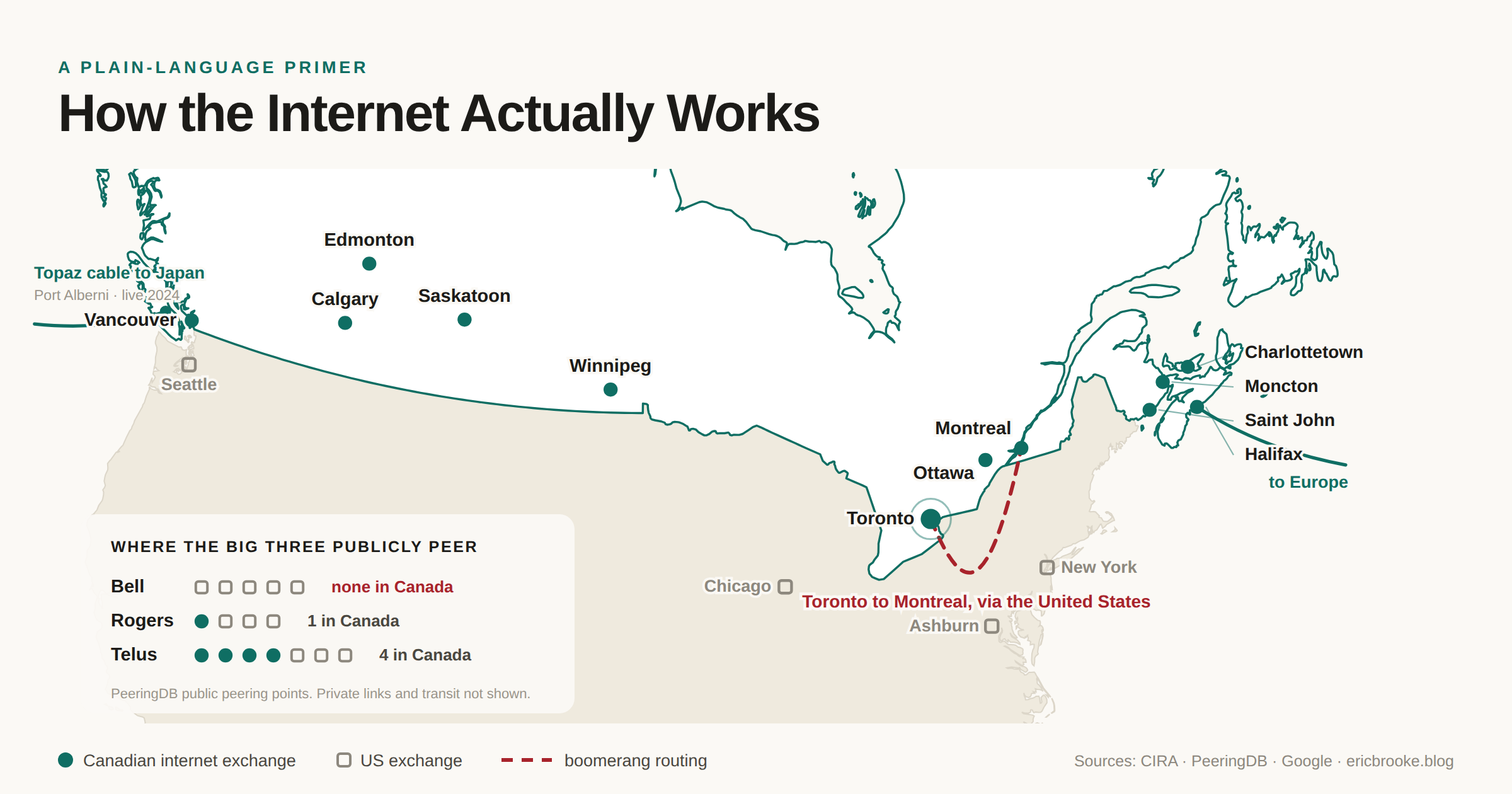
The biggest Canadian meeting point is TorIX, the Toronto Internet Exchange, founded in 1997 and now the largest exchange point in the country. It’s a not-for-profit. Over 250 organisations connect to it, from buildings including 151 Front Street West in Toronto.[9][10] Canada now has roughly 12 internet exchange points, in cities from Vancouver to Charlottetown.[11]
Boomerang routing. For a long time (and still, in some cases) data sent from one Canadian city to another would leave the country, travel through the United States, and come back. Hence the name. Why? Because Canadian providers bought their links from American networks. It was cheaper than building connections to each other at home.
CIRA runs the .ca domain, and it puts this plainly. Many Canadian providers buy their links through the United States. CIRA calls that “costly and inefficient.”
Their fix is exchange points. Build enough of them here, CIRA says, and “data travelling between Canadian entities never needs to leave the country.”[11]

Researchers at the University of Toronto add a second worry. It isn’t only about speed and cost. Data that crosses a border falls under another country’s surveillance laws.[12] You can decide for yourself how much weight to put on that, but the physical fact (that the packets go where the wires go, not where the border is) is not in dispute.
So who actually does it?
Every network that connects to an exchange point lists itself in a public directory called PeeringDB. Anyone can look it up. Here is what Canada’s providers report.
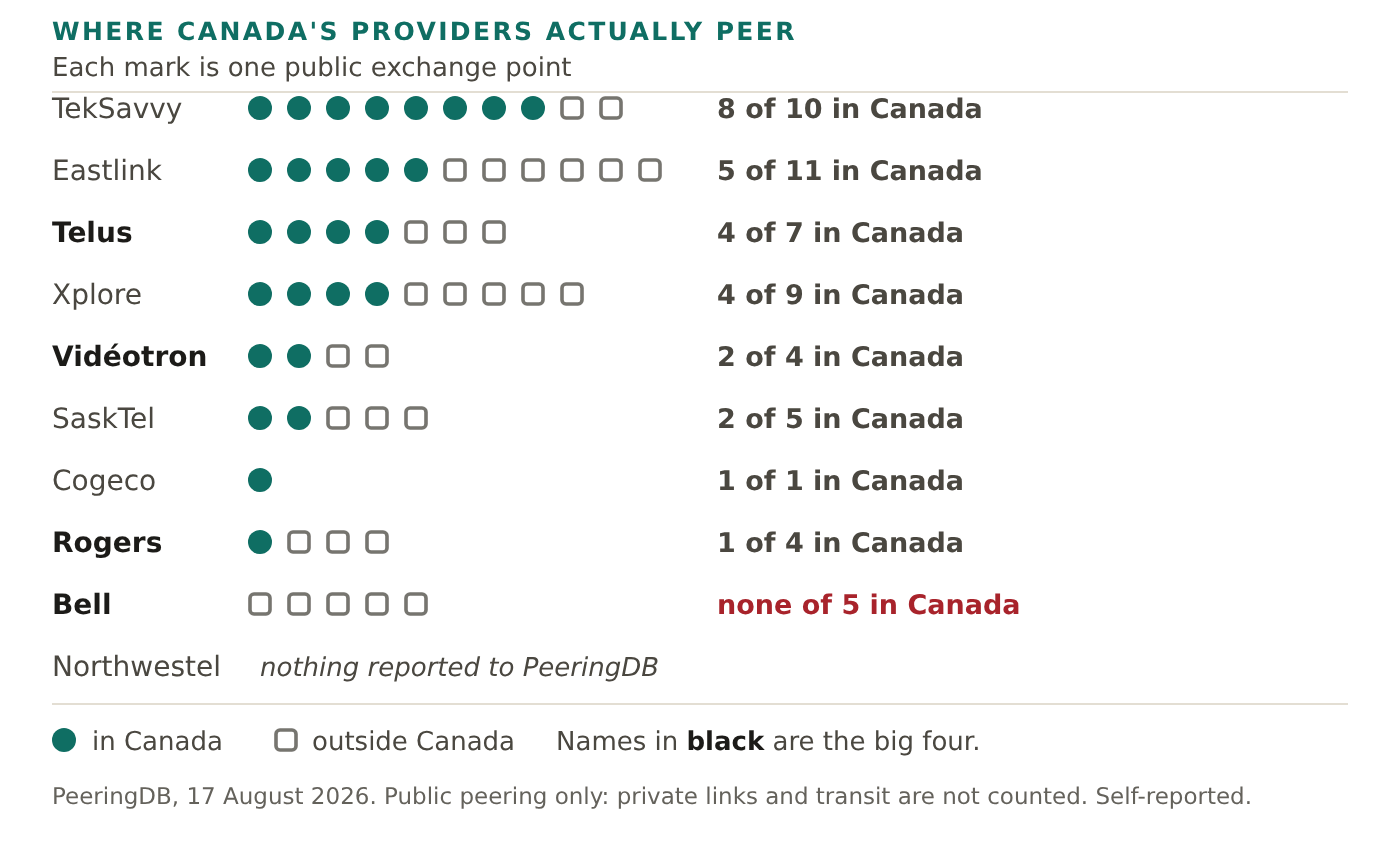
Read the bottom of that list first. Bell is Canada’s largest internet provider, and it reports no public peering in Canada at all: five exchange points, every one of them in the United States.[94] Rogers reports one.
Now read the top. TekSavvy is a small independent that mostly rents capacity on other companies’ lines, and it has eight of its ten exchange points in Canada. More domestic presence than any of the big four.
The pattern runs roughly opposite to what you’d guess. The bigger the company, the less likely it is to swap traffic with other Canadians on Canadian soil.
Three things this chart does not say
This is the kind of graphic that gets screenshotted and misread, so here are its limits.
- It counts public peering only. All of these companies also run private links and buy transit, and none of that appears here. Bell obviously moves Canadian traffic inside Canada. What it doesn’t do is meet other networks at open exchange points.
- The data is self-reported. SaskTel’s and Northwestel’s entries haven’t been touched since 2022, and Cogeco’s single listing is implausibly thin for a company with roughly a million subscribers. Some of these numbers are probably stale rather than wrong.
- Northwestel’s blank is not a zero. It’s a company that hasn’t filled in the form. Absence of data and data showing absence are different things, and only one of them is a finding.
What the chart does show is a choice. An exchange point is where you meet everybody at once, on equal terms. A private link is where you meet one company, on terms the two of you negotiate. Large carriers tend to prefer the second, and smaller networks the first, because a small network has more to gain from being in the room.
That’s worth knowing before anyone tells you boomerang routing gets fixed just by building more exchange points. The exchange points exist. Getting the biggest players to use them is a different problem, and it isn’t a technical one.
Where the cables land. Halifax is one of the places transatlantic cables come ashore in Canada.[13]
Atlantic Canada has done this job a long time. The first transatlantic telegraph cable that worked landed at Heart’s Content, Newfoundland, in 1866, which is the same ocean and more or less the same idea, a century and a half earlier.
The .ca ending is Canada’s own piece of the naming system from Part 6. It’s run by CIRA, a Canadian non-profit. Not a government department. Not a foreign company.[14]
Check yourself, Part 11
Try to answer before you look. Recalling it is what makes it stick; rereading only feels like it does.
1. What is boomerang routing, and why did it happen to Canada?
Answer
Data travelling between two Canadian places leaving the country and coming back. It happened because many Canadian providers bought their connectivity through American networks instead of connecting to each other at home.
2. What does an internet exchange point do about that?
Answer
It gives networks a neutral building where they can hand traffic straight to each other. If both networks meet at TorIX, Toronto-to-Toronto traffic never leaves Toronto.
Part 12Padlocks, privacy and staying safe
Remember from Part 5 that your packets get read and handled by every router in between. In the early days, that meant anyone along the path could read what you sent, like mailing every letter as a postcard.
The fix is encryption: scrambling a message so only the intended recipient can unscramble it. That’s what the s in HTTPS means. When your browser shows a padlock, three things are true:
- The contents are scrambled, so routers in the middle see gibberish.
- Nobody in the middle can secretly change what you sent.
- The site proved it is who it claims to be, using a digital certificate issued by an organisation your browser trusts.
This used to be rare. In 2015, fewer than 30% of web connections were encrypted. It’s now around 80% globally and close to 95% in the U.S., largely because a non-profit called Let’s Encrypt began giving away certificates for free, they now protect close to a billion websites.[15]
What the padlock does not mean
HTTPS proves your connection to the site is private. It does not mean the site is honest, safe, or telling the truth. A scam site can have a perfect padlock. Encryption protects the delivery, not the contents.
Stop and thinkEncryption protects the delivery of your message but not what you chose to send. What would it take to protect the contents too, and could any technology do that?
Who can see what
- Your ISP can see which sites you connect to (the names, from your DNS lookups and connection addresses) but with HTTPS it can’t read the pages themselves.
- The website sees your IP address, roughly what device you’re on, and whatever you type into it.
- Whoever runs the Wi-Fi you’re using sees roughly what your ISP sees. Public Wi-Fi is much safer than it used to be because of HTTPS, but it’s still someone else’s network.
Three habits worth building
- Different password for every account. Companies get broken into. If one password gets stolen and you used it everywhere, everything opens. A password manager makes this painless.
- Two-step login where it’s offered. A stolen password alone then isn’t enough to get in.
- Slow down when something is urgent. Nearly every successful scam works by creating panic — your account is locked, you’ve won something, act now. Real organisations are fine with you closing the message and going to their website yourself.
Check yourself, Part 12
Try to answer before you look. Recalling it is what makes it stick; rereading only feels like it does.
1. A site shows a padlock. What does that prove, and what does it not prove?
Answer
It proves your connection is scrambled, unaltered, and that the site is who it claims to be. It does not prove the site is honest or safe. A scam site can have a perfect padlock. Encryption protects the delivery, not the contents.
2. Why is using one password everywhere dangerous even if it’s an excellent password?
Answer
Because companies get broken into, and that’s outside your control. However good the password, one break-in somewhere else opens everything you own.
Part 13Who owns the internet? (Nobody)
This surprises people. There is no head office. There is no CEO of the internet. No single country, company or person owns or controls it.
What exists instead is a set of organisations that each look after one narrow, boring, essential thing:
- ICANN coordinates the naming and numbering, the DNS from Part 6 and the addresses from Part 3, making sure
.cameans one thing worldwide and no two machines get the same address. - The IETF writes the technical rules. Anyone can join. Anyone can propose a change. The rules are published as free documents called RFCs, “Requests for Comments,” a name that tells you a lot about the culture. The IETF’s famous motto is that it believes in “rough consensus and running code”: if you want to change how the internet works, the way to win the argument is to build something that works and show people.
- Regional registries hand out blocks of IP addresses to networks in each part of the world.
- Thousands of separate companies and organisations own the actual cables, routers and buildings. Your ISP owns its bit. A university owns its bit. Nobody owns the whole.
This is why the internet is hard to switch off, and also why nobody can force it to improve. Change happens by persuasion and by lots of separate parties choosing to adopt something. It’s slow. It is also the reason one physicist’s side project at CERN could become the World Wide Web without needing anybody’s permission.
Check yourself, Part 13
Try to answer before you look. Recalling it is what makes it stick; rereading only feels like it does.
1. Who is in charge of the internet?
Answer
Nobody. ICANN coordinates names and numbers, the IETF writes the technical rules and anyone can propose a change, regional registries hand out addresses, and thousands of separate organisations own the actual cables and routers.
2. The IETF’s motto is “rough consensus and running code.” What does that tell you about how the internet changes?
Answer
That you win an argument by building something that works and showing people, not by having authority. It’s slow, and it’s why one physicist’s side project could become the Web without anyone’s permission.
Part 14What it costs the planet
All of this runs on electricity. The warehouses full of servers, the routers running 24 hours a day, the cooling systems keeping it all from overheating, and the device in your hand.
The numbers
- In 2024, data centres used about 415 terawatt-hours of electricity. That’s roughly 1.5% of all the electricity in the world. The International Energy Agency expects that to about double by 2030 (to 945 TWh, just under 3%) mostly because of AI.[16]
- Cooling takes water. A very large site can draw up to 5 million gallons a day — about what a town of 10,000 to 50,000 people uses. But many use far less, and some use almost none. One estimate put all U.S. data centres together at 449 million gallons a day in 2021. Be careful with water numbers: they’re much patchier than the energy ones, because most operators don’t publish them.[18]
Two things are true at once here, and it’s worth holding both.
The internet also saves a great deal of energy. A video call instead of a flight. A downloaded album instead of a shipped CD. A doctor’s appointment you don’t drive to.
Those are real savings. For a lot of things, the digital version is far lighter than the physical one it replaced.
But the growth is real and speeding up. And one thing matters more than almost anything else: where the electricity comes from.
Take two identical data centres. Run one on hydro power in Quebec. Run the other on coal. Same building, same machines, completely different footprint.
Most of Canada’s electricity is already low-carbon. That makes this one of the better places on Earth to put a data centre, worth knowing when you hear about a new one being built near you.
Stop and thinkTwo identical data centres, one in Quebec and one somewhere else, can have very different footprints. Why? You already have everything you need to answer this.
So the useful response isn’t guilt about watching a video. It’s knowing which questions to ask.
Where does the power come from? Is the cooling water returned to the river, or used up? Are the machines getting efficient faster than demand is growing?
All three have real answers. All three are worth asking when someone proposes a new facility near you.
Check yourself, Part 14
Try to answer before you look. Recalling it is what makes it stick; rereading only feels like it does.
1. Between 2010 and 2018 the computing done by data centres grew about 550%. What happened to their electricity use?
Answer
It rose only about 6%. Efficiency improvements swallowed almost all the growth. For a decade we got vastly more internet for almost no extra power.
2. That era has now ended. Why should you trust that claim more than most energy claims?
Answer
Because four of the researchers who documented the good news are also authors on the 2024 report saying it stopped, including its lead author. People changing their minds on evidence is a strong signal.
3. The projection for 2028 is “325 to 580 TWh.” What is that range telling you?
Answer
That the forecasters are being honest about uncertainty: the top is nearly double the bottom. Read the range, not the midpoint, and definitely not whichever end a headline picked.
Part 15The whole journey, start to finish
This part is deliberate revision. Everything in it has appeared already; this is the first time you’ll see all of it moving at once, which is a different thing from having read about each piece.
You’re on a couch in Toronto. You type cbc.ca and press Enter. Here is everything that happens, in order, in roughly a quarter of a second.
- Your laptop needs a number, not a name. It asks its DNS resolver: what’s the address for cbc.ca?
- The resolver either remembers, or asks a root server, then the
.caserver, then CBC’s own name server, and comes back with an IP address. - Your laptop opens a connection to that address. It sends a short “hello, are you there?” packet, the server answers, your laptop confirms. This three-message handshake takes one round trip and must finish before any real data moves.
- Then comes the encryption handshake, the two sides agree on a secret scramble, and your laptop checks the server’s certificate. That’s the padlock appearing. Only now can a real request be sent.
- Your laptop builds the request, “please send me the homepage”, and hands it to TCP, which chops it into numbered packets. IP stamps each one with the destination and your return address.
- The packets go out over Wi-Fi radio to your router, then down the wire from your building.
- Your ISP’s routers pass them hop by hop toward the destination. If CBC’s network and your ISP both connect at TorIX, the packets may never leave Toronto. If not, they might detour through the U.S. and back.
- The packets reach a server in a data centre, which reassembles them and reads the request.
- The server sends the page back, in packets, over whatever route works right now.
- Your laptop reassembles them in order, notices packet 112 is missing, asks for just that one again, gets it, and completes the set.
- Your browser reads the HTML, requests the images and styling (each of which repeats steps 1–9), and draws the page.
Eleven steps. Dozens of machines. Several countries, possibly. Glass, copper, radio waves and electricity. And a set of rules that a few thousand people wrote down and gave away for free.
That’s the internet. Not a cloud. A machine you can point at.
Check yourself, Part 15
Try to answer before you look. Recalling it is what makes it stick; rereading only feels like it does.
1. Put these in the right order: the encryption handshake, the DNS lookup, the TCP handshake, the browser drawing the page.
Answer
DNS lookup first (name to number), then the TCP handshake (hello, are you there?), then the encryption handshake (agree a secret, check the certificate — the padlock appears), then the request, then the page is drawn.
2. Roughly how long does that whole journey take?
Answer
About a quarter of a second, across dozens of machines and possibly several countries.
Part 16What happens next — connecting everyone
Nobody knows the future of the internet. But not all guesses are equally worthless, and telling them apart is a skill you can actually learn.
So this section does something the rest of the primer doesn’t: it labels its own confidence. Every claim below carries one of three tags, and you should treat them very differently.
How to read this section
Happening now Someone has actually measured this. It could still reverse, but it isn’t a prediction; it’s a report.
Committed, could slip A real organisation published a real deadline. Deadlines slip constantly. The commitment is the fact; the date is the guess.
Nobody knows Genuine expert disagreement. Anyone giving you a confident answer here is selling something. What I can give you instead is what to watch.
Getting everyone connected
Happening now The address shortage is quietly ending. Remember IPv4 running out? On 28 March 2026, for the first time, more than half the people reaching Google did so over IPv6, 50.1%.[19] Eighteen years after the transition began.
Two honest caveats on that. It was a single-day peak, not a permanent crossing, 28 March was a Saturday, and these numbers run higher at weekends when people are on home connections. And other measurers disagree: around the same time APNIC said about 42–43%, and Cloudflare said 40.1%.[19]
None of them is lying. Google measures its own visitors. APNIC weights its samples by each country’s estimated number of internet users. Cloudflare counts web requests. When three careful sources disagree, the answer is a range, not a winner.
A prediction that failed, and what it teaches
For twenty years the story was that IPv4 addresses would become desperately scarce and expensive. Addresses really are bought and sold. But in the first half of 2026 the priced market saw about 5 million addresses change hands across 596 deals, at an average of $20 per address, down about 36% in a year, and down roughly 60% from the 2021–22 peak.[20]
The price fell. And the number of deals went up, 596, against 420 a year earlier. So this isn’t demand collapsing; it’s a price reset. People found workarounds, mostly by sharing one address among many devices, and by finally moving to IPv6.
The shortage was real. The crisis wasn’t. Keep this in mind for every other shortage you get warned about, including some in this very section.
Happening now Satellites are finally doing something useful. Not for the backbone; that’s still cables, as Part 10 explained. But for the places cables were never going to reach. As of 8 August 2026 an independent astronomer’s catalogue counted 10,923 working Starlink satellites in orbit.[21] SpaceX said in June 2026 that it had 12 million customers, that second figure is the company’s own, and nobody audits it.[22]
The Canadian one to watch: Telesat Lightspeed
Committed, could slip Canada is building its own satellite network, on a different model from Starlink.
On 4 August 2026, Telesat announced a C$2.3 billion contract with Canada’s Defence Investment Agency for connectivity across the Arctic, from 65° to 90° North, and expanded the constellation from 156 to 225 satellites, raising capacity 44%.[23] The satellites are built by MDA Space in Montreal, under a separate C$474 million award.
It’s financed by a C$2.14 billion federal loan and a C$400 million Quebec loan. In return, the two governments hold warrants for roughly 12% of the company’s satellite division.[24] Public money, with public upside attached, worth noticing either way you feel about it.
The key difference from Starlink: Telesat doesn’t sell to you. It sells wholesale to governments and to internet providers, who sell to you. In the North that means Northwestel, which signed on in April 2026.[25] Starlink sells direct. Which model serves remote communities better is a live argument, not a settled one.
On the date: Telesat now says global service starts Q1 2028.[23] Earlier plans had satellites launching in mid-2026. That has already slipped. Treat the date as a direction, not a promise.
Happening now Canada’s connection gap is not where the headline says it is. The target is 50 Mbps down and 10 Mbps up for 98% of Canadians by 2026 and 100% by 2030. As of May 2026 the national figure was 97.4%.[26] Nearly there.
Now look underneath the average, which is where averages always hide the story:
of urban Canada meets the 50/10 target
of the three territories
of First Nations reserves

Careful with those last two: they come from the CRTC’s 2024 survey, published in March 2026, so they’re about eighteen months older than the 97.4%.[27] The gap has probably narrowed since then, though nothing suggests it has closed.
To make it concrete: in Nunavut today the home internet package is 15 Mbps down, 2 Mbps up, with a 300 GB monthly cap, and it’s sold in only four of the territory’s twenty-five communities.[28] That’s under a third of the speed the rest of the country calls a minimum, with a limit most households elsewhere would blow through in a week.
In April 2026 the federal government committed $87 million to bring all 25 communities to 50/10 with no data cap by March 2029 — about 11,650 households, delivered by Northwestel using fibre and Telesat capacity.[28] Construction can’t start until after the 2027 sealift, the annual ocean resupply that brings heavy materials north before the ice returns.
There is no more Canadian sentence in this entire document: the internet build schedule is set by when the ice lets the ships in.
Committed, could slip 6G is real, and further away than the advertising suggests. In June 2026, 3GPP, the body that actually writes mobile standards, approved the timeline. The protocol freeze lands in December 2028, with the final code freeze in March 2029.[29] The ITU’s window for submitting candidate technologies runs February 2027 to February 2029, with evaluation continuing after that.[30]
No standards body, regulator or operator has committed to a commercial deployment date. The “around 2030” you’ll see quoted is an industry expectation worked backwards from the standards schedule, a reasonable inference, but not a promise from anyone. Anything sold as 6G before 2029 is a trial.
Check yourself, Part 16
Try to answer before you look. Recalling it is what makes it stick; rereading only feels like it does.
1. Google says IPv6 has passed 50%. APNIC says about 43%. Cloudflare says 40%. Who’s lying?
Answer
Nobody. They measure different populations in different ways — Google’s own visitors, population-weighted samples, and web requests. When three careful sources disagree, the answer is a range, not a winner.
2. Canada is 97.4% connected at 50/10. What’s hiding underneath that average?
Answer
Urban Canada is at 99.8%, the three territories at 69.6%, and First Nations reserves at 65.7%. The national average is a way of not talking about the North.
Part 17AI is changing what the internet is for
More than half of internet traffic is no longer people. That single fact is reshaping who the web gets built for, and what it costs to run.
Happening now Most internet traffic is no longer people. In July 2026, Cloudflare, which sits in front of a large share of the web and can therefore count, reported that more than half of internet traffic is now non-human. Software talking to software. And the mix shifted: 52% of crawler requests were for AI training as of June 2026, up from 22% in spring 2025.[31]

This matters because it strains an old bargain. For thirty years the deal was: let search engines read your pages, and they send you readers. In the week of 19–26 June 2025, Cloudflare measured one AI company making about 70,900 page requests for every single visitor it sent back.[32]
Watch me not overstate this
That 70,900 figure gets quoted constantly, usually rounded up and stripped of its date. Here’s what actually happened next. Between January and July 2025 that same company’s ratio fell by about 87%, to roughly 38,000 to one.[33]
But, and this is the part almost nobody quotes, that improvement wasn’t industry-wide. Over the same months OpenAI’s ratio fell only about 10%, and Google’s got worse, rising from about 3.8 to 5.4 pages per referral.[33] One company improving sharply is not “the problem is being solved.”
I looked for a mid-2026 figure and could not verify one from a primary source. Plenty of websites publish confident 2026 numbers. None of them cite retrievable data. So this primer doesn’t give you one.
Happening now People are clicking through less. The best evidence isn’t a survey; it’s real browsing behaviour. Pew Research watched what 900 American adults actually did across 68,879 Google searches in March 2025. When an AI summary appeared, people clicked a normal search result 8% of the time. With no summary, 15%. Roughly half. Only 1% clicked a link inside the summary itself.[34]
Google disagrees. In August 2025 the head of Google Search wrote that total clicks to websites were “relatively stable year-over-year.” That post contains no figures, no chart and no methodology.[35]
You’re allowed to weigh a published, replicable measurement against an unquantified assertion from an interested party, and reach a conclusion. That isn’t bias. That’s how evidence works. It would also be fair to note that Pew measured one month, in one country, early in the rollout, and that Google can see data nobody outside the company can, both of which are fair points to hold at the same time.
Nobody knows How this gets settled. Two routes are open. One is public standards: the IETF has a working group writing a successor to robots.txt, the decades-old file where a site states what crawlers may take. As of April 2026 it was still a draft, with no published standard.[36] The other route is one company deciding. Since July 2025 Cloudflare has asked every new site whether to allow AI crawlers, and from 15 September 2026 it blocks training and agent crawlers by default on pages that show ads.[37]
Stop and thinkWhy would a website happily let a search engine read every page, but not an AI company? What did it get from the search engine that it doesn’t get from the AI?
A humbling detail: as of June 2025, only about 38% of the top 10,000 websites had a robots.txt file at all, and among those, one major AI crawler was blocked by about 8%.[38] The polite old system was barely used before anyone started fighting about it.
The electricity problem, honestly
Happening now Here is the fact that reframes the whole energy conversation, and almost nobody mentions it.
Between 2010 and 2018, global data centre electricity use rose about 6%. Over the same period the amount of computing they did rose about 550%, their storage grew about 25-fold, and internet traffic grew more than tenfold.[39] Efficiency swallowed nearly all the growth. For a decade we got vastly more internet for almost no extra power.
That era is over. A US national lab report in December 2024 states it plainly: the shift to AI hardware “ended the era of generally flat data center energy use.” American data centres went from about 60 TWh in 2014, 1.8% of national electricity, to 176 TWh in 2023, or 4.4%.[40]
The strongest thing about this claim is who makes it. Four of the researchers behind the good-news 2020 paper are also authors on the 2024 report announcing it had ended, including its lead author.[39][40] The people who documented the efficiency miracle are the ones telling you it stopped. That’s what updating on evidence looks like, and it’s why I weight this above most energy claims you’ll read.
Committed, could slip That same report projects US data centres at 325 to 580 TWh by 2028, somewhere between 6.7% and 12% of all American electricity.[40]
Notice the top of that range is nearly double the bottom. The width is the message. When forecasters publish an honest range, read the range, not the midpoint, and definitely not whichever end a headline picked.
Real pressure is already showing up on real grids:
- Ireland. Data centres used 23% of all metered electricity in the country in 2025, up from 5% in 2015.[41] More than all rural households combined. Since December 2025, new Irish data centres must bring their own generation or storage to match what they draw.[42]
- The US mid-Atlantic. In the December 2025 auction that secures future power supply for the PJM grid, prices hit the regulatory cap. Of roughly 5,250 MW of forecast load growth, PJM attributed about 5,100 MW to data centres — around 97%, though that percentage is my arithmetic on their two numbers, not a figure PJM prints.[43]
- Alberta. The grid operator received 29 data centre connection requests totalling more than 16,000 MW and capped new connections at 1,200 MW while it works out a framework.[44] Queue numbers are requests, not commitments, most projects in any interconnection queue never get built.
- Quebec. In February 2026 Hydro-Québec asked its regulator to charge new data centres over 5 MW 13¢/kWh, and crypto mining 19.5¢, roughly double current large-industrial rates. The stated reason: make these industries cover their own costs.[45]
How to read a scary statistic — a worked example
In June 2026 a US senator said that near large data centres, electricity bills “have gone up by as much as 267%.” A fact-check rated it Mostly False.[46]
Was the 267% invented? No. It was real, it just measured wholesale prices at specific points on the grid: what utilities pay generators, not what lands on your bill. Wholesale supply is only about 30–50% of a household electricity bill.[46] The number itself was true; it was the sentence built around it that wasn’t.
The accurate version is still striking: US residential electricity prices rose about 42% in five years, and 94% in Washington DC.[46] And experts broadly agree data centres push costs up. The speaker didn’t need the bad number.
The habit worth building: when a figure seems too dramatic, ask “a percentage of what, measured where, over what period?” Most misleading statistics are true numbers wearing the wrong label. That’s much harder to spot than a lie, and far more common.
Check yourself, Part 17
Try to answer before you look. Recalling it is what makes it stick; rereading only feels like it does.
1. One AI company’s crawling ratio improved by about 87% in six months. Does that mean the problem is fixing itself?
Answer
No. Over the same period OpenAI’s ratio fell only about 10% and Google’s actually got worse. One company improving sharply is not a trend.
2. Someone tells you electricity bills near data centres rose “as much as 267%.” What should you ask?
Answer
A percentage of what, measured where, over what period. That figure was wholesale prices at particular points on the grid, and wholesale is only 30–50% of a household bill. The number was true; the sentence around it wasn’t.
Part 18Who gets to control it
The popular story is that the internet is splitting apart. The measured story is stranger: it is technically holding together while quietly concentrating into very few hands.
This is the most politically contested thread in the primer, so I’ll be careful, including about the claims that would flatter my own framing.
Happening now Governments switch the internet off more than they used to. In 2025 there were 313 documented shutdowns across 52 countries, a record, up from 304 in 2024 and 289 in 2023. Myanmar led with 95, then India with 65.[47]
Now question the number I just gave you
The organisation that publishes it warns you itself: cases “may have gone unreported,” and it names Myanmar as having hundreds more shutdowns nobody documented.[47]
Stranger still: India tops the list partly because India is transparent. Indian courts require shutdown orders to be published, which makes them countable. That’s the tracker’s own explanation, not mine.[47]
And countries like China barely appear — not because they’re open, but because, in the tracker’s words, systematic censorship and a domestic intranet mean authorities rarely need to switch anything off. A permanent wall doesn’t register as an outage.
One more thing: a one-hour outage and a year-long blackout each count as “1.”
This is a real number from a careful organisation, and it still can’t be read the obvious way. Good sources tell you their own limits; it’s a strong signal when they do, and a warning when they don’t.
Happening now Undersea cables keep getting cut, and the sabotage story is weaker than the headlines.
Start from the baseline in Part 10: 150 to 200 cable faults happen every year, normally. The industry body that tracks them says 70–80% are accidents, anchors and fishing gear, and deliberate damage is under 1% of the annual total.[48] Any individual cut is far more likely to be a bad day at sea than an act of war.

Now the famous incidents, and what investigators actually concluded:
- Taiwan, January 2025. A ship’s captain was convicted and sentenced to three years, upheld on appeal. This is the one real conviction. But prosecutors did not bring the harsher national-security charge — by their own account, they never established who, if anyone, directed him.[49]
- Sweden–Latvia, January 2025. Swedish prosecutors closed the case as an accident: bad weather, technical faults and suspected poor seamanship.[50]
- Finland–Estonia, December 2024. Charges were dismissed in October 2025 because the court found Finnish law didn’t reach the incident under the law of the sea. It never ruled on whether it was deliberate. Under appeal.[50]
- Baltic, November 2024. Swedish investigators concluded it could not be determined whether the damage was intentional. They did not rule sabotage out, and they were obstructed, unable to interview the crew aboard.[50]
- Red Sea, February 2024. The leading theory, still not confirmed, is the dragging anchor of a cargo ship that had been hit by a missile and abandoned. Damage caused by a war, but probably not a cable-cutting operation.[51]
The summary that survives checking: a cluster of suspicious incidents in tense waters, where attribution has repeatedly failed to survive contact with a courtroom. That is genuinely worrying, it suggests the law struggles to reach this. But “we couldn’t prove it” is not “we proved it,” and a primer that blurred those two would be teaching you a bad habit while claiming to teach you a good one.
Happening now The real change is concentration, not fragmentation. Three companies run most of the world’s cloud: Amazon 28%, Microsoft 20%, Google 15%, 63% between them as of mid-2026.[52]
You can watch the consequence when one of them stumbles. On 18 November 2025, Cloudflare had its worst outage since 2019 and large parts of the web returned errors for about five and a half hours. It was not an attack, Cloudflare said so explicitly. A routine database permissions change made an internal configuration file roughly double in size, pass a hard limit nobody expected to hit, and crash the software that handles traffic.[53] A month earlier, an Amazon region went down for about fourteen and a half hours because of a timing bug in its own automated DNS system that produced an empty record.[54]
Part 2 said the internet has no single point of failure. That’s still true of the design. It’s becoming less true of the practice, because so much now rests on so few providers, and both of those outages were self-inflicted configuration errors, not attacks. The failure mode isn’t villains. It’s complexity.
The “splinternet” — a popular idea that mostly doesn’t survive checking
You’ll hear the internet is splitting into separate national internets. Technically, that is not what’s happening. There’s still one DNS root (the thing from Part 6), one address system and one set of protocols, so everyone is still speaking the same language even where they disagree about everything else.
The clearest test came in 2022, when Ukraine formally asked ICANN to strip Russia of its domain names and shut down root servers there. ICANN refused. Its response said the organisation “has no sanction-levying authority,” that its mission “does not extend to taking punitive actions,” and that unilateral changes “would erode trust in the multistakeholder model.”[55] A parallel request to the European address registry was also refused. The technical layer held under the strongest political pressure it has ever faced.
Russia’s own “sovereign internet” system appears to mirror the global root rather than replace it, same namespace, different answers. On the public technical evidence it’s a censorship chokepoint, not a separate internet. And despite repeated announcements, no full national disconnect has been publicly demonstrated; the December 2024 test covered three regions, not the country.[56]
The fair steelman for the other side: if what you can reach depends on your jurisdiction, then your experienced internet is fragmented, whether or not the root zone forked. That’s a real point, and I don’t want to wave it away. But it locates the fragmentation in law and business rather than in the wires, which changes who you’d talk to about it.
Canada already ran this experiment
Happening now The Online News Act became law, and since 1 August 2023 Meta has blocked news links on Facebook and Instagram in Canada. No protocol changed. No cable was cut. A company changed a setting.
Measured effects, from a Canadian university research group in 2026: news organisations’ Facebook posts fell 65% and Instagram posts 74%. In the six months after the block, engagement with news fell 48% in large cities, but 89% in mid-sized cities and rural areas.[57] The places with the fewest local outlets lost the most.
And the part that should stay with you: as of January 2026, only 41% of Canadian Facebook users correctly knew news was blocked. Thirty percent actively believed it wasn’t.[57] Most people didn’t experience a blackout. They experienced a slightly emptier feed and drew no conclusion at all.
The lesson isn’t whether the law was good or bad, reasonable people disagree, and the study makes no finding on that. It’s that what actually changed what Canadians could see was a policy decision and a corporate response, and almost nobody noticed. Wires are visible. Rules aren’t.
Check yourself, Part 18
Try to answer before you look. Recalling it is what makes it stick; rereading only feels like it does.
1. Undersea cables keep getting cut. What’s the normal rate, and how much of it is sabotage?
Answer
150 to 200 faults every year, normally. Around 70–80% are accidents, anchors and fishing gear, and deliberate damage is under 1% of the annual total.
2. Is the internet splitting into separate national internets?
Answer
Technically, no. There’s still one DNS root, one address system, one set of protocols, and ICANN refused to revoke Russia’s domains even under enormous pressure in 2022. What fragments is law and business decisions, not the wires.
3. A single company’s failure took much of the web offline for over five hours in November 2025. Was it an attack?
Answer
No, a routine database change made an internal file grow past a size limit and crash the software. Both of the big 2025 outages were self-inflicted configuration errors. The failure mode isn’t villains; it’s complexity.
Part 19Proving things are real
The internet is replacing every lock it has, and almost nobody noticed. Meanwhile the problem of proving a photo is genuine turns out to have no solution at all.
Happening now The internet is quietly replacing all its locks, and you probably haven’t noticed.
Remember the padlock from Part 12. The maths behind it, where your browser and a server agree on a shared secret, relies on problems that are hard for ordinary computers. A sufficiently powerful quantum computer would make them easy.
Nobody has built one. But there’s a specific reason not to wait, and it has a name: “harvest now, decrypt later.” Someone can record your encrypted traffic today, store it, and decrypt it in fifteen years when the machine exists. If what you sent still matters then (medical records, state secrets, someone’s identity) it was never really protected.
So the replacement is already underway, and it has been remarkably fast. The new algorithms were published by the US standards body on 13 August 2024.[58] Here is Cloudflare’s measurement of its own traffic since:

Over 65% by April 2026, from under 3% at the start of 2024.[59] You took part in this. You did it by updating your browser.
The counterweight: only about 10% of origin servers, the machines actually holding the websites, support the new method.[59] Protection needs both ends. Browsers moved fast; the rest of the internet has not.
Committed, could slip There are now real deadlines. A US executive order signed in June 2026 requires federal systems to have quantum-resistant key exchange on their most important systems by the end of 2030, and signatures by the end of 2031.[60] The UK’s cyber security centre set milestones at 2028, 2031 and 2035.[61]
Nobody knows When a quantum computer could actually break today’s encryption. This is the genuinely open question, so here’s the spread rather than a number.
A survey of 26 specialists, published in 2026, put the odds of breaking today’s standard encryption within ten years at 28–49%, and within fifteen years at 51–70%.[62] That spread is the disagreement, these are experts who cannot agree with each other.
Meanwhile the engineering estimates keep falling. In 2019 a leading researcher estimated 20 million qubits would be needed; by 2025 the same researcher said under one million.[63] More aggressive 2026 estimates go lower still, but one of them would need 120 years of running time to actually finish the job, a detail the headlines drop.[64] For scale: Google’s Willow chip has 105 physical qubits.[64]
So: no official body names a date. Institutions are acting on 2030–2035 anyway. That’s not a contradiction; it’s what good risk management looks like when you don’t know. You don’t have to predict the fire to buy the extinguisher.
Proving a picture is real (and why it can’t quite work)
Nobody knows As AI-made images improve, there’s a push to attach a tamper-evident record to photos — where taken, by what camera, what edits were made. The main effort is called C2PA, or Content Credentials, backed by Adobe, the BBC, Google, Microsoft, OpenAI, Sony and others. Some Google Pixel and Sony cameras support it. It is not yet an international standard.[65]
Here’s why I’ve tagged this “nobody knows” rather than “happening now”:
- Four countries’ cyber security agencies, including Canada’s, published a joint note stating that the credential “does not allow a consumer to determine whether a piece of content is true.” It records who, when and how. Not whether.[66]
- A peer-reviewed teardown in April 2026 found that different conforming checkers disagree about the same file, that timestamps aren’t properly bound to the content, and that signing certificates expire long before the legal retention periods for the media they sign.[67]
- Ordinary re-encoding by social platforms strips the credential entirely.
- Privacy researchers warn the same records could reveal which journalist took a photo, on which device.[68]
- And the one that can’t be engineered away: point a certified camera at a screen showing a fake, and you get a perfectly valid credential.
Provenance can attest to a pipeline. It can never attest to reality. That isn’t a bug someone will fix; it’s the shape of the problem. Which means judging whether a source is trustworthy is a skill no badge is going to replace.
Check yourself, Part 19
Try to answer before you look. Recalling it is what makes it stick; rereading only feels like it does.
1. What does “harvest now, decrypt later” mean?
Answer
Someone records your encrypted traffic today and stores it, planning to decrypt it in fifteen years when a quantum computer exists. If what you sent still matters then, it was never really protected.
2. Post-quantum encryption went from under 3% of traffic to over 65% in about two years. How did you personally take part?
Answer
By updating your browser. That’s what participating in internet infrastructure looks like for almost everyone.
3. Why can a content credential never prove that a photograph shows something real?
Answer
Because you can point a certified camera at a screen displaying a fake and get a perfectly valid credential. Provenance can attest to a pipeline. It can never attest to reality.
Part 20Telling true from false
Proving a photo is real is a technical problem. Proving a claim is true is a human one, and there is a specific, teachable habit that works. This is the most useful part of the primer.
First, three words worth being precise about. Canada’s own cyber security centre defines them like this:[75]
- Misinformation, false, but shared by someone who thinks it’s true.
- Disinformation, false, and spread deliberately to manipulate people.
- Malinformation, based on truth, but exaggerated or twisted so it misleads.
The difference is intent. Someone’s uncle sharing a wrong health tip is misinformation. A government paying people to post that same tip is disinformation. Identical falsehood, completely different problem, completely different fix. Lumping them together is how most arguments about this go wrong in the first thirty seconds.
Happening now False stories really do travel faster, inside one specific pool. In 2018, MIT researchers studied about 126,000 stories shared on Twitter over eleven years. Falsehoods reached 1,500 people roughly six times faster than true stories, and were 70% more likely to be re-shared.[76]
And the finding that should stay with you: bots spread true and false news at exactly the same rate. The reason falsehood won was people. Humans did it, by choosing what to pass on.[76]
Now let me correct the way that study is usually used
That study looked only at stories that fact-checkers had already picked up and disputed. Within that pool, falsehood wins. But the pool is tiny.
A separate study measured what Americans actually consumed all day, every screen, all sources. Fake news came to about 0.15% of their daily media diet.[77] Not 15%. Zero point one five. Its authors concluded that being misinformed probably comes more from ordinary news, or from avoiding news altogether, than from outright fakery.
A 2024 review in Nature was blunter: exposure to false and inflammatory content is “rare and concentrated among a narrow fringe” of people who go looking for it.[78]
Both things are true at once. Among disputed stories, lies spread faster. Disputed stories are a sliver of what anyone actually sees. The error (made constantly, including by news outlets reporting the study) is turning “false news spreads six times faster” into “most of what you see online is false.”
Researchers who study this have a name for that mistake: misinformation about misinformation.[79] If a section on misinformation doesn’t warn you about its own field, be suspicious of it.

Happening now Why it works on you anyway: repetition. Hearing a statement a second time makes it feel truer. The unsettling part, demonstrated repeatedly since 2015, is that this happens even when you already know the right answer. Psychologists call it “knowledge neglect”, your brain uses the feeling of familiarity as a shortcut instead of checking the facts it already holds.[80]
The scale, honestly: the effect is small, not overwhelming. A nudge, not a spell. But it works on wild conspiracy claims and boring trivia at about the same strength,[80] and it stacks.
Which gives you something genuinely useful: the thing to watch for isn’t one brilliant lie. It’s the same small claim, a hundred times, from a hundred accounts. Repetition is the technique. Recognising repetition as a technique is most of the defence.
Nobody knows The AI catastrophe that hasn’t arrived, yet. Before the 2024 elections, a great many people predicted deepfakes would decide them. Researchers went and looked afterwards. In the UK general election they found 16 confirmed viral cases of AI disinformation; across the EU and French elections, 11. They found no evidence any result was affected.[81]
Canada’s 2025 federal election got measured too. Researchers found 5.86% of election-related images on X, Bluesky and Reddit were deepfakes. That sounds alarming, until you look at who saw them. Harmful deepfakes were 0.12% of all views on X, and nearly half of all the deepfakes found were jokes or not political at all.[82] (That study is a preprint and hasn’t been peer-reviewed yet, so treat the numbers as preliminary.)
Prevalence and reach are different things. Something can be everywhere and seen by almost nobody. Any statistic that gives you one without the other is only half a fact.
Do not file this as “so it’s fine.” The same researchers document real harm that has nothing to do with election results: deepfake pornography targeting women in politics, more than $200 million in deepfake-driven fraud in early 2025 alone, and a newer trick, flooding the web with fake articles specifically to poison what AI chatbots repeat.[83]
So the sentence that fits the evidence is three separate claims, and you should resist anyone who merges them: no proven effect on election outcomes. Rising volume and sophistication. Real, documented harm elsewhere.
The one habit that actually works
Researchers gave the same web pages to three groups: 10 professional fact-checkers, 10 history PhDs, and 25 Stanford students.
One task: which of two doctors’ organisations is more trustworthy? One was the real professional body. The other was a small splinter group with a similar-sounding name and a very official-looking website.
fact-checkers got it right
of the history PhDs did
of Stanford students picked the splinter group
These are not unintelligent people. The students were taken in by a logo and a convincing web address.[84]
The difference wasn’t intelligence, and it wasn’t knowledge. It was a habit.
The historians and students read vertically, they stayed on the page and studied it closely, the way you’d read a book. The fact-checkers read laterally: they left almost immediately, opened new tabs, and asked a different question: what does the rest of the internet say about whoever made this page?

On another task, fact-checkers uncovered a hidden public-relations-firm connection in an average of 51 seconds. The historians took nearly four minutes. Eighty percent of the students never thought to check who was paying for the site at all.[84]
The researchers’ own summary is the line worth memorising: the fact-checkers “read less but learned more.”
Read laterally — the whole method in five steps
- Leave the page. This is the hard one, because it feels lazy. It isn’t. The page is the thing you’re judging; it can’t grade its own homework.
- Open a new tab. Search the name of the site, the author, or the organisation — plus a word like funding, who owns, or criticism.
- Skip their About page. Anyone can write anything about themselves. You want what other people say about them.
- Find the original. If a claim points to “a study,” go find the study. Very often it says something much narrower than the headline. This primer’s own 267% example in Part 17 is exactly that.
- Check the date. An enormous amount of what circulates as breaking news is real news from years ago, resurfaced with a new caption.
That’s it. It takes under a minute once it’s a habit, and it beats being clever.
The caveat I owe you: that study had 10, 10 and 25 people in it. It’s been hugely influential and the mechanism makes obvious sense, but it is one small study, and I’d be breaking my own rules if I called it settled. Notice that you just applied the skill to the study about the skill.
What’s been tested, and how well it works
Three approaches have been properly trialled. Here’s what they actually deliver, including where the researchers disagree with each other.
- Teaching lateral reading. The clearest mechanism of the three. In one study of 574 students, scores rose from 2.25 to 3.75 out of 9 after lessons.[85] Look at the second number: after the training they still got fewer than half right. Real improvement. Nowhere near solved.
- Prebunking. Short videos that show you a manipulation trick before you meet it in the wild. A large study (about 30,000 people, including 22,632 on YouTube) found solid gains in lab conditions but only about a 5% improvement in the real-world YouTube test.[86] Critics argue the gains are mostly generalised suspicion of everything, including true news, rather than a better ability to tell them apart, and a 2026 preregistered study found no improvement in that ability at all.[87] That disagreement is unresolved. Also worth knowing: game-based versions fade within about nine days, while video versions last around a month.[88]
- Accuracy nudges. Simply prompting someone to think about whether a headline is accurate, before they share. The first big result was later replicated at about half the original size.[89] Everyone now converges on roughly the same answer: real, robust, and small, around a 10% reduction in sharing false headlines.[90]
The most encouraging thing here isn’t any of the three results. It’s that the two rival research groups, who spent years publicly finding fault with each other’s work, eventually ran a study together to test whether their methods combined.[91]
That’s what the thing this primer keeps pointing at actually looks like in practice. Not certainty. People arguing in public, in a way that lets them be shown wrong, and then changing their minds where the evidence goes.
Canada, specifically
Statistics Canada asked about this in spring 2025:[92]
- 80% of Canadians saw something online they suspected was false at least once a month.
- 61% are very or extremely concerned about misinformation.
- 47%, nearly half, say it’s harder to tell true from false than it was three years ago.
And a fact that surprises most people: Canadian law does not regulate misinformation. The Online Harms Act died when Parliament was prorogued in January 2025. Its replacement, the Safe Social Media Act, was introduced in June 2026 and covers seven specific categories — child sexual abuse material, non-consensual intimate images, hate speech, incitement to violence, content encouraging self-harm in children, cyberbullying of children, and terrorist content.[93]
“Being false” is not on that list, and was not on the previous one either. That is a deliberate and consistent choice, and worth understanding before you argue about it in either direction: Canada regulates specific harms, not falsity. Deciding what’s true is not a job Canadian law hands to anybody.
Which means the checking is yours to do. That’s either alarming or empowering, and honestly it’s both.
One last thing.
Go back and look at Reginald Fessenden’s card, near the cables in Part 10.
His 1900 achievement, the first human voice sent by radio, has a plaque on an island in Maryland. His 1906 Christmas Eve broadcast has no newspaper coverage from the time and didn’t surface until the late 1920s. Both stories circulate. The second one circulates more, because it’s a better story.
That’s the whole problem, in one man, from 1906. It is not new. The internet didn’t invent it, and no badge, law or algorithm is going to solve it for you.
The answer isn’t “trust nothing”; that’s just a different way of being fooled, and it’s the failure mode the prebunking critics are worried about. The answer is smaller and much more doable:
Leave the page. Open a tab. Find out which one has the plaque.
Who has to prove how old they are
Happening now Several countries now require age checks to reach parts of the internet. The UK’s rules took effect in July 2025; Australia banned under-16s from major social media in December 2025. Canada’s version, Bill S-209, passed the Senate in April 2026 and is awaiting second reading in the House of Commons; it is not law.[69]
The early results are genuinely mixed, and worth seeing before anyone tells you it obviously worked or obviously failed:
- UK, one year on: more than 69 million age checks across 32 services in six months, and the share of children encountering checks rose from 25% to 43%. But 33% of first-page Google results still led to sites with no checks at all.[70]
- Australia, seven months on: 4.7 million under-16 accounts removed or restricted, yet about 70% of children who had accounts before the ban still had them, and there was no clear drop in cyberbullying complaints.[71]
- How children actually get around checks: 63% by lying about their age. Only about 10% use tools that disguise their location.[72] The VPN angle got most of the coverage; it’s the smaller effect.
Both sides, stated properly. Digital rights groups point at a concrete cost: an age-verification supplier used by Discord was breached in October 2025, exposing around 70,000 government ID images.[73] Meanwhile more than 50 children’s safety organisations and bereaved families signed a statement in January 2026 supporting effective age assurance while opposing blanket under-16 bans, arguing bans push children toward less safe places and cut off support networks for vulnerable young people, including LGBTQ+ teenagers.[74]
So the real disagreement isn’t “age checks: yes or no.” It’s bans versus graduated, risk-based checks, and who ends up holding your identity documents. If someone presents this to you as a simple two-sided fight, they haven’t read the people they claim to agree with.
What you can actually affect
Almost everything in Parts 16 to 20 is a decision, not a weather forecast. Decisions have deciders, venues and dates. Here’s where the ones above get made, and every item on this list takes public input.
Things a person in Canada can genuinely watch or push on
- Where data centres get built, and what they pay for power. Hydro-Québec’s rate application goes to the Régie de l’énergie. Alberta’s connection framework goes through the AESO. These are public proceedings with comment periods, and the outcome decides whether new industrial demand is subsidised by your bill or pays its own way.
- The last 2.6%. The national broadband figure will cross 98% and the story will be declared finished. 65.7% on First Nations reserves is the number that will still be true. The CRTC opened a dedicated Indigenous stream for its Broadband Fund in 2026, with public consultation.[27]
- Bill S-209. It sits between the Senate and the Commons right now. That’s exactly the window in which a bill’s details change, and the details (who holds the ID, whether checks happen per-site or per-device) matter far more than the headline.
- Who sets the rules for AI crawlers. Either an open standards body settles it in public (the IETF’s mailing lists and meetings are readable by anyone, no membership required) or one large company settles it with a default setting. Those produce very different internets.
- Update your devices. The least glamorous item and the most effective. Post-quantum encryption reached 65% of traffic because hundreds of millions of people clicked “update.” For most of us, that is what participating in internet infrastructure looks like.
Check any of this yourself
Everything in these five parts came from organisations that publish their raw data and their methods. You don’t have to take my word for it, and you shouldn’t:
- radar.cloudflare.com — live traffic, bot share, encryption adoption, outages by country
- ised-isde.canada.ca, Canada’s broadband map, searchable by address
- root-servers.org, every DNS root server, live
- accessnow.org, internet shutdowns, with the methodology and its limits written out
- iea.org and lbnl.gov, energy figures, with the model assumptions published
If a claim about the internet doesn’t have something like this behind it, that absence is the finding.
One last thing
Every part of this primer describes something people built and could have built differently. TCP/IP was given away instead of patented. CERN put the Web in the public domain. ICANN said no to a superpower’s ally. Someone decided Nunavut’s internet build waits for the sealift. Someone is deciding, right now, what a data centre pays for electricity in Quebec.
The internet isn’t weather. It’s an enormous pile of arguments that got settled, most of them in public, many by people who weren’t important at the time. Those arguments are still open, and you can read them.
That’s the actual point of understanding how it works.
Check yourself, Part 20
Try to answer before you look. Recalling it is what makes it stick; rereading only feels like it does.
1. What’s the difference between misinformation and disinformation?
Answer
Intent. Both are false. Misinformation is shared by someone who thinks it’s true; disinformation is spread deliberately to manipulate. You can end up with an identical falsehood either way, but they are different problems and they need different fixes.
2. “False news spreads six times faster than the truth.” What’s missing from that sentence?
Answer
The scope. That was measured only among stories fact-checkers had already disputed. Across everything people actually consume all day, fake news is about 0.15% of the media diet.
3. What is the one habit shown to work, and what’s its first step?
Answer
Lateral reading. First step: leave the page. Open a new tab and find out what the rest of the internet says about whoever made it. That is how the fact-checkers ended up reading less of each page and knowing more about it.
Words you now know
- Packet
- A small numbered piece of a larger message, with a from-address and a to-address on it.
- IP address
- The numeric address of a device on the internet. IPv4 looks like 208.80.153.224; IPv6 is much longer and there are vastly more of them.
- Router
- A machine that reads a packet’s destination and forwards it one step closer. It only knows the next hop, not the whole path.
- Hop
- One step from one router to the next.
- DNS
- The Domain Name System, the internet’s phone book, turning names like cbc.ca into numbers.
- Root server
- The top of the DNS hierarchy. 13 names, over 2,000 actual machines worldwide.
- Server
- A computer left switched on to answer requests. Lives in a data centre.
- Client
- A device that makes requests — your phone, laptop, console.
- TCP / UDP
- The two main ways of packaging data. TCP checks nothing was lost; UDP is faster but doesn’t check.
- HTTP / HTTPS
- The rules for requesting web pages. The S means encrypted.
- ISP
- Internet Service Provider, the company that connects you to everyone else.
- IXP
- Internet Exchange Point, a neutral building where many networks meet and swap traffic directly.
- Encryption
- Scrambling a message so only the intended recipient can read it.
- Boomerang routing
- When data between two points in one country leaves and re-enters it on the way.
- The Web
- One kind of traffic on the internet, linked pages, viewed in a browser. Invented twenty years after the internet.
- Data centre
- A warehouse full of servers, kept cool and powered. What people mean by “the cloud.”
- Handshake
- The short back-and-forth two machines do to open a connection, before any real data moves.
- ICANN
- The body that coordinates names and numbers worldwide, so no two machines get the same address.
- IETF
- The open body that writes the internet’s technical rules. Anyone can join and propose a change.
- Anycast
- Copying one address onto many machines worldwide, so your request goes to the nearest copy.
- Misinformation
- False information shared by someone who believes it’s true.
- Disinformation
- False information spread deliberately, to manipulate.
- Malinformation
- Information based on truth, but exaggerated or twisted so it misleads.
- Lateral reading
- Leaving a page to check elsewhere who made it, instead of studying the page itself. The habit that works.
- Deepfake
- An image, video or voice generated or altered by AI to look real.
- Post-quantum encryption
- New scrambling methods designed to survive a future quantum computer.
Sources
Every number and date in this primer traces to one of these. Where a figure was current as of a specific date, that date is noted, because these change.
- ITU, Facts and Figures 2025 — Internet use. 6 billion users, 74% of the world’s population, ~2 billion offline. itu.int
- Internet Society, FAQ on IPv6 adoption and IPv4 exhaustion. IPv4 ≈ 4.3 billion addresses; IPv6 = 2128. internetsociety.org
- Netnod, DNS root server FAQ. Why there are 13 root server names. netnod.se
- Root Server Technical Operations Association. 2,003 operational instances, 12 operators, as of 11 August 2026. root-servers.org
- ICANN, The First Message Transmission (2019). Charley Kline, UCLA to SRI, 29 October 1969; “lo”. icann.org
- CERN, The birth of the Web. Web software placed in the public domain 30 April 1993. home.cern
- CERN, Web at 30 — Web History. March 1989 proposal; December 1990 first browser, server and website. web30.web.cern.ch
- TeleGeography, Submarine Cable FAQs. 600+ cables, 1.5 million km, ~200 faults/year, garden-hose thickness, satellites at 0.37% of U.S. international capacity (FCC). Figures as of early 2026. telegeography.com
- TorIX, Who is TorIX?. Not-for-profit, 250+ connected organisations. torix.ca
- Wikipedia, Toronto Internet Exchange. Founded 1997; largest IXP in Canada; sites at 151 Front St W, 45 Parliament St, 905 King St W. wikipedia.org
- CIRA, Internet Exchange Points. 12 Canadian IXPs; north-to-south transit through the U.S. described as costly and inefficient. cira.ca
- Obar, J. & Clement, A., Internet Surveillance and Boomerang Routing: A Call for Canadian Network Sovereignty. papers.ssrn.com · See also the IXmaps research project: ixmaps.ca
- Submarine Networks, Halifax Cable Landing Station. submarinenetworks.com
- CIRA, About CIRA. Canadian non-profit managing the .CA domain. cira.ca
- Let’s Encrypt, 10 Years of Let’s Encrypt Certificates (December 2025). HTTPS from under 30% in 2015 to ~80% globally and ~95% in the U.S.; approaching one billion sites protected. letsencrypt.org
- International Energy Agency, Energy and AI — Energy demand from AI. Data centres ≈415 TWh (1.5% of global electricity) in 2024; base case ≈945 TWh (just under 3%) by 2030. iea.org
- Vint Cerf, Marking the birth of the modern-day Internet, Google. The 1 January 1983 switch from NCP to TCP/IP. blog.google
- Environmental and Energy Study Institute, Data Centers and Water Consumption. Large facilities up to 5 million gallons/day; U.S. data centres ≈449 million gallons/day in 2021; average WUE 1.9 L/kWh. eesi.org
- The Register, Google says IPv6 finally passed 50% (April 2026), and APNIC Blog, Google hits 50% IPv6 (28 April 2026). 50.1% single-day peak on 28 March 2026; APNIC ~42–43%, Cloudflare 40.1%, mid-April 2026. Different measurers, different populations. blog.apnic.net
- CircleID, IPv4 Market in H1 2026: A Price Reset, Not a Market Collapse. ~5.0M addresses across 596 priced transactions, average $20.04, down 35.7% year-on-year; ~$52 for large blocks in late 2023. circleid.com
- Jonathan McDowell, Starlink Statistics. 10,939 in orbit, 10,923 working, as of 8 August 2026. Independently catalogued. planet4589.org
- SpaceX, announced 4 June 2026: over 12 million active customers in 160+ countries. Company-reported and not independently audited. finance.yahoo.com
- Telesat press release, 4 August 2026. C$2.3 billion 15-year Arctic contract with Canada’s Defence Investment Agency, 65°–90°N; constellation 156→225 satellites, +44% capacity; MDA Space C$474M award; global service from Q1 2028. telesat.com
- Telesat press release, 13 September 2024. C$2.14B federal loan with warrants for 10% of Telesat LEO shares; C$400M Quebec loan with warrants for a further 1.87%. telesat.com
- Northwestel and Telesat, 2 April 2026. Multi-year agreement to buy Lightspeed capacity and retail 50/10 unlimited in the North. telesat.com
- Innovation, Science and Economic Development Canada, Progress toward universal access to high-speed Internet. 97.4% national at 50/10 as of May 2026; urban 99.8%, rural 87.4%; targets 98% by 2026 and 100% by 2030. ised-isde.canada.ca
- CRTC news release, 18 March 2026, reporting 2024 Facilities Survey data: territories 69.6%, First Nations reserves 65.7%. Note the figures are from 2024 even though published in 2026. Also announces the Broadband Fund’s Indigenous stream consultation. canada.ca
- 3GPP, Release 21 timeline, published 10 June 2026. Protocol (Stage-3) freeze December 2028; ASN.1/OpenAPI freeze March 2029. 3gpp.org
- ITU-R WP 5D IMT-2030 process timeline. Technology submission window February 2027 – February 2029, with evaluation and consensus-building continuing after. techblog.comsoc.org
- Cloudflare, The agentic Internet: a bot traffic report, 1 July 2026. More than 50% of internet traffic non-human; 52% of crawler requests for AI training as of June 2026, up from 22% in spring 2025. blog.cloudflare.com
- Cloudflare, Crawl-to-refer ratios on Radar, 1 July 2025. ~70,900 page requests per referral for one AI crawler, week of 19–26 June 2025. blog.cloudflare.com
- Cloudflare, From crawl to click, 29 August 2025. One crawler’s ratio fell from 286,930:1 in January 2025 to 38,065:1 in July — about 87%. Over the same period OpenAI’s fell ~10% and Google’s rose from 3.8 to 5.4. blog.cloudflare.com
- Pew Research Center, published 22 July 2025 (data collected March 2025). 900 US adults, 68,879 Google searches: 8% clicked a result when an AI summary appeared vs 15% when none did; 1% clicked a link inside the summary. pewresearch.org
- Liz Reid, VP and Head of Google Search, 6 August 2025: total organic click volume “relatively stable year-over-year.” The post contains no figures, chart or methodology. blog.google
- IETF AIPREF working group documents. As of April 2026 still an Internet-Draft; no RFC published. datatracker.ietf.org
- Cloudflare press release, 1 July 2025 (every new domain asked whether to allow AI crawlers, plus pay-per-crawl), and Content Independence Day, 1 July 2026 (from 15 September 2026, training and agent crawlers blocked by default on ad-displaying pages for new domains). blog.cloudflare.com
- Cloudflare, From Googlebot to GPTBot: who’s crawling your site in 2025, 1 July 2025. robots.txt found on 3,816 of the top 10,000 domains (38%); GPTBot disallowed by 312 of those (8.2% any disallow, 6.5% full block). Sample dated 6 June 2025. blog.cloudflare.com
- Masanet, Shehabi, Lei, Smith & Koomey, Recalibrating global data center energy-use estimates, Science, 28 February 2020. Energy +6% from 2010–2018 while compute instances +550%, storage ×25, IP traffic more than ×10. datacenters.lbl.gov
- Shehabi, Smith, Hubbard, Newkirk, Lei, Siddik, Holecek, Koomey, Masanet & Sartor, 2024 United States Data Center Energy Usage Report, Lawrence Berkeley National Laboratory, December 2024. “Ended the era of generally flat data center energy use.” 60 TWh (1.8%) in 2014 → 176 TWh (4.4%) in 2023 → 325–580 TWh (6.7–12.0%) projected for 2028. Note the overlapping author list with the 2020 paper. eta-publications.lbl.gov
- Central Statistics Office (Ireland), Data Centres Metered Electricity Consumption 2025, released 7 July 2026. 23% of metered electricity in 2025, up from 5% in 2015. cso.ie
- Commission for Regulation of Utilities (Ireland), decision on new electricity connection policy for data centres, 12 December 2025. cru.ie
- PJM Interconnection, 2027/2028 Base Residual Auction results, 17 December 2025. Cleared at the FERC-approved cap of $333.44/MW-day; of ~5,250 MW of forecast load growth, ~5,100 MW attributed to data centre demand. The “97%” is arithmetic on those two figures, not a number PJM publishes. pjm.com
- Alberta Electric System Operator, 4 June 2025. 29 proposed data centre projects totalling more than 16 GW; interim connection limit of 1,200 MW. globenewswire.com
- Hydro-Québec application to the Régie de l’énergie, filed 19 February 2026. 13¢/kWh for data centres over 5 MW; 19.5¢/kWh for blockchain and crypto mining. lapresse.ca
- PolitiFact, 12 June 2026, rating a 5 June 2026 statement Mostly False. The 267% figure describes wholesale nodal prices (April 2020 – April 2025), and wholesale supply is 30–50% of a retail bill. Accurate comparators: US residential prices up ~42% over five years; Washington DC up 94% (March 2021 – March 2026). politifact.com
- Access Now / #KeepItOn, Internet Shutdowns in 2025 annual report, March 2026. 313 shutdowns in 52 countries (304 in 2024, 289 in 2023); Myanmar 95, India 65. Includes the methodology’s own limits: undocumented cases, Myanmar undercounted, India’s court-published orders, and why continuous-censorship states record few shutdowns. accessnow.org
- International Cable Protection Committee, media FAQ, updated 20 May 2026. 150–200 faults per year; 70–80% from accidental human activity; sabotage under 1% of annual damage. iscpc.org
- Tainan District Court, 12 June 2025; upheld by the Taiwan High Court Tainan Branch, 29 August 2025. Three-year sentence for intentional cable damage. Prosecutors’ own release confirms the party directing the act was never identified; the harsher national-security-tier offence was not charged. pf.org.tw
- Baltic incidents. Sweden–Latvia (Vezhen): Swedish prosecutors closed the case 14 October 2025, finding weather, technical faults and suspected poor seamanship, not a deliberate act. Finland–Estonia (Eagle S): Helsinki District Court dismissed charges 3 October 2025 on jurisdiction under the law of the sea, without ruling on intent; under appeal. Baltic November 2024 (Yi Peng 3): Swedish Accident Investigation Authority, 15 April 2025 — it “cannot be determined with certainty” whether damage was intentional; sabotage not ruled out, and investigators were denied access to interview the crew. valtioneuvosto.fi
- Kentik, What caused the Red Sea submarine cable cuts?, 31 March 2024. The dragging anchor of the abandoned Rubymar is described as “the leading theory” but “yet to be confirmed.” kentik.com
- Synergy Research Group, 30 July 2026. Q2 2026 cloud infrastructure share: Amazon 28%, Microsoft 20%, Google 15%. srgresearch.com
- Cloudflare post-mortem, Cloudflare outage on November 18, 2025. Explicitly “not caused, directly or indirectly, by a cyber attack.” A database permissions change doubled the rows in a bot-management feature file, exceeding a hardcoded limit and crashing the proxy. Impact 11:28–17:06 UTC. blog.cloudflare.com
- Amazon Web Services post-event summary, us-east-1, 19–20 October 2025. “A latent race condition in the DynamoDB DNS management system that resulted in an incorrect empty DNS record.” Full resolution across services took about 14.5 hours. aws.amazon.com
- ICANN CEO Göran Marby to Ukraine’s Minister of Digital Transformation, 2 March 2022, declining to revoke Russian domains or disable root servers. ICANN “has no sanction-levying authority”; its mission “does not extend to taking punitive actions.” A separate request to RIPE NCC regarding IP addresses was also refused. icann.org
- The Record, on Russia’s regional internet-disconnection test of 7–9 December 2024 covering Chechnya, Dagestan and Ingushetia. On NSDI mirroring rather than replacing the ICANN root, see the SplinterCon technical presentation of 13 June 2024 — note this is an unattributed conference paper, the weakest source cited in this primer. therecord.media
- Media Ecosystem Observatory (McGill / University of Toronto), The News Canadians Actually See, Summer 2026. Facebook posts by news outlets −65%, Instagram −74%; engagement −48% in large cities vs −89% in mid-sized cities and rural areas; survey of 8–13 January 2026 found only 41% of Facebook users correctly knew news was blocked, with 30% believing it was not. mediatechdemocracy.com
- NIST, first three finalised post-quantum encryption standards (FIPS 203, 204, 205), published 13 August 2024. nist.gov
- Cloudflare, Post-quantum roadmap, 7 April 2026. Over 65% of human traffic post-quantum encrypted, from under 3% at the start of 2024, 29% at the start of 2025 and 52% in December 2025 — but only about 10% of origin servers support it. blog.cloudflare.com
- US Executive Order 14412 and OMB Memorandum M-26-15, June 2026. Post-quantum key establishment on high-value systems by 31 December 2030; digital signatures by 31 December 2031. whitehouse.gov
- UK National Cyber Security Centre, Timelines for migration to post-quantum cryptography, 20 March 2025. Discovery and planning by 2028; highest-priority migrations by 2031; complete by 2035. ncsc.gov.uk
- Global Risk Institute / evolutionQ, Quantum Threat Timeline Report 2025, published 9 March 2026. Survey of 26 experts: 28–49% likelihood of breaking RSA-2048 within 10 years; 51–70% within 15 years. globalriskinstitute.org
- Craig Gidney, How to factor 2048 bit RSA integers with less than a million noisy qubits, 21 May 2025 — revising the same author’s 2019 estimate of 20 million qubits. arxiv.org
- Physics World, 26 May 2026, on 2026 resource estimates. A ~10,000-qubit approach would need roughly 120 years of runtime against RSA-2048; Google’s Willow chip has 105 physical qubits. Treat aggressive estimates as resting on assumptions that still require future breakthroughs. physicsworld.com
- Coalition for Content Provenance and Authenticity. Specification 2.4 (April 2026); ISO/CD 22144 not yet published as an international standard. c2pa.org
- NSA, Australia’s ACSC, the Canadian Centre for Cyber Security and UK NCSC, Content Credentials: Strengthening Multimedia Integrity in the Generative AI Era, January 2025. Content Credentials do “not allow a consumer to determine whether a piece of content is ‘true’.” media.defense.gov
- Golaszewski, Krawetz, Sherman, Zieglar et al., Verifying Provenance of Digital Media: Why the C2PA Specifications Fall Short, 23 April 2026. Conforming validators disagree on the same file; timestamps not cryptographically bound to content; certificate expiry conflicts with legal retention periods. arxiv.org
- World Privacy Forum, Privacy, Identity and Trust in C2PA, June 2025. Warns that provenance metadata can identify a specific device and owner, with particular risk to journalists. worldprivacyforum.org
- Parliament of Canada, Bill S-209, Protecting Young Persons from Exposure to Pornography Act. Passed the Senate 15 April 2026; first reading in the House of Commons 30 April 2026; awaiting second reading. parl.ca
- Ofcom, one-year report on Online Safety Act age checks, 15 July 2026. Over 69 million age checks across 32 services in six months; children encountering checks up from 25% to 43%; 33% of first-page Google results still led to unprotected sites. ofcom.org.uk
- Australian eSafety Commissioner evaluation, reported July 2026, on the under-16 social media minimum age in force from 10 December 2025. 4.7 million accounts removed or restricted; roughly 70% of children who previously had accounts still had them; no clear decline in cyberbullying complaints. theconversation.com
- UK Department for Science, Innovation and Technology / BMG, Children’s circumvention behaviours online, 14 July 2026 (n=2,299, ages 11–17). 39% had circumvented an age check at least once; 63% of those did so by posing as someone else; about 10% used location-changing tools. gov.uk
- Electronic Frontier Foundation, Age verification is a privacy nightmare, 28 May 2026, citing the October 2025 breach of a third-party age-verification vendor used by Discord, which exposed roughly 70,000 government ID images. eff.org
- Joint statement from 50+ children’s and online-safety organisations, experts and bereaved families, January 2026, supporting highly effective age assurance while opposing blanket under-16 social media bans. mollyrosefoundation.org
- Canadian Centre for Cyber Security (CSE), How to identify misinformation, disinformation, and malinformation (ITSAP.00.300), updated March 2024. The three definitions are quoted from this page. cyber.gc.ca
- Vosoughi, Roy & Aral, The spread of true and false news online, Science 359(6380), 9 March 2018. ~126,000 stories, ~3 million people; truth took about six times as long as falsehood to reach 1,500 people; falsehoods 70% more likely to be retweeted; bots spread true and false news at the same rate. science.org
- Allen, Howland, Mobius, Rothschild & Watts, Evaluating the fake news problem at the scale of the information ecosystem, Science Advances 6(14), 3 April 2020. News of any kind is at most 14.2% of Americans’ daily media diet; fake news is 0.15%. science.org
- Budak, Nyhan, Rothschild, Thorson & Watts, Misunderstanding the harms of online misinformation, Nature 630, 5 June 2024. A review, not new data: exposure is “rare and concentrated among a narrow fringe with strong motivations to seek out such information.” nature.com
- Altay, Berriche & Acerbi, Misinformation on Misinformation: Conceptual and Methodological Challenges, Social Media + Society, 28 January 2023. Notes that the 2018 Twitter study sampled only already-disputed stories — a limit its own authors acknowledged — and that the nuance was lost in coverage. journals.sagepub.com
- Fazio, Brashier, Payne & Marsh, Knowledge does not protect against illusory truth, Journal of Experimental Psychology: General 144(5), 2015 — the “knowledge neglect” finding. Replicated for implausible and conspiracy statements: Fazio, Rand & Pennycook (2019) and Bowes & Fazio, registered replication, Psychonomic Bulletin & Review, 2026. Effect sizes are small (d ≈ 0.2–0.4). link.springer.com
- Alan Turing Institute / CETAS, AI-Enabled Influence Operations: Threat Analysis of the 2024 UK and European Elections, 19 September 2024. 16 confirmed viral cases in the UK general election, 11 across the EU and French elections; no evidence of impact on any result. cetas.turing.ac.uk
- Livernoche, Musulan, Yang, Godbout & Rabbany (Mila / McGill / Université de Montréal), Deepfakes in the 2025 Canadian Election, December 2025. 5.86% of election images were deepfakes; harmful ones were 0.12% of views on X; 49.4% of detected deepfakes were benign or non-political. Preprint — not peer-reviewed. arxiv.org
- CETAS / Alan Turing Institute, From Deepfake Scams to Poisoned Chatbots: AI and Election Security in 2025, 17 November 2025. Over $200 million in deepfake-driven fraud in early 2025; data-poisoning attacks aimed at contaminating AI chatbot outputs; still no evidence of tangible impact on 2025 election outcomes. cetas.turing.ac.uk
- Wineburg & McGrew, Lateral Reading and the Nature of Expertise, Teachers College Record 121(11), 2019. 10 fact-checkers, 10 historians, 25 Stanford undergraduates. Fact-checkers 2.0/2.0, historians 0.7/2.0, students 0.16/2.0, with 60% of students choosing the splinter group; fact-checkers averaged 51 seconds to uncover a PR-firm connection. Note the small sample. stacks.stanford.edu
- McGrew & Breakstone, Civic Online Reasoning Across the Curriculum, AERA Open 9(1), 2023. 574 ninth-graders, pretest 2.25 → posttest 3.75 out of 9. The authors note it was not a randomised trial and had no control group. files.eric.ed.gov
- Roozenbeek, van der Linden, Goldberg, Rathje & Lewandowsky, Psychological inoculation improves resilience against misinformation on social media, Science Advances 8(34), 24 August 2022. Six randomised studies (n=6,464) plus a YouTube field study (n=22,632); manipulation-technique recognition rose about 5% in the field test. science.org
- Modirrousta-Galian & Higham, Journal of Experimental Psychology: General, 2023, and Seabrooke, Modirrousta-Galian & Higham, Psychonomic Bulletin & Review, 2026. Argue via signal detection theory that these interventions mostly produce general scepticism rather than better discrimination between true and false, and identify a difficulty confound in earlier positive results. discovery.ucl.ac.uk
- Maertens, Roozenbeek, Simons, Lewandowsky, Maturo, Goldberg, Xu & van der Linden, Psychological booster shots targeting memory increase long-term resistance against misinformation, Nature Communications 16:2062, 11 March 2025. N=11,759. Game-based effects were not significant at 9 days; video-based retained roughly 78% of effect at 30 days. nature.com
- Roozenbeek, Freeman & van der Linden, How accurate are accuracy-nudge interventions? A preregistered direct replication, Psychological Science 32(7), 11 June 2021. Roughly 50% attenuation of the original effect. journals.sagepub.com
- Pennycook et al., Shifting attention to accuracy can reduce misinformation online, Nature 592, 17 March 2021; and Pennycook & Rand, Accuracy prompts are a replicable and generalizable approach, Nature Communications 13:2333, 2022 — 20 experiments, N=26,863, about a 10% reduction in sharing false headlines. The authors describe the effects as “modest in size.” nature.com
- Nature Human Behaviour, 2024: Inoculation and accuracy prompting increase accuracy discernment in combination but not alone — the two rival research groups publishing together. nature.com
- Foran & Bilodeau, Shifting perceptions of misinformation in Canada, Statistics Canada, released 13 May 2026 (Canadian Social Survey Wave 17, collected spring 2025). 80% saw suspected false information at least monthly; 61% very or extremely concerned; 47% say it is harder to tell true from false than three years ago. www150.statcan.gc.ca
- Government of Canada, Safe Social Media Act (Bill C-34), introduced 10 June 2026 — seven content categories, none of which is falsity. Its predecessor, the Online Harms Act (Bill C-63), died on the Order Paper when Parliament was prorogued on 6 January 2025. C-34 was not yet law at the time of writing. canada.ca
- PeeringDB, retrieved 17 August 2026. Public peering points per network: Bell AS577 (5, none in Canada), Rogers AS812 (4, one), TELUS AS852 (7, four), Vidéotron AS5769 (4, two), Cogeco AS11290 (1, one), Eastlink AS11260 (11, five), SaskTel AS803 (5, two), Northwestel AS22573 (none reported), TekSavvy AS5645 (10, eight), Xplore AS22995 (9, four). Shaw AS6327 is a separate record but has been part of Rogers since April 2023 and is not counted separately. peeringdb.com
- Canadian Telecommunications Association, quarterly high-speed internet subscriber statistics, Q1 2026, used to identify the largest providers by subscribers. The CRTC does not publish a per-company ranking for internet, and the Association’s table covers only six carriers, so ranks beyond those are based on regional footprint rather than a published count. canadatelecoms.ca

