Get to know your Weather
It is always worth looking at what weather your house could experience as understanding this could lead to you saving more money and protect the house and yourselves better.
Find good weather data for your location
It was quite hard to parse all of the weather information and find reliable summaries (most weather sites seem to try to make money out of travel) and a lot had old data. The Canadian Government Weather Sites have all the data to pull from. I found the local city reports were very useful especially from Toronto City, they have done a lot of the work for you.
Each type of weather will affect your house. Whilst we often replace or upgrade parts of our house as separate “things” we often do not consider the impact on the whole house. Thinking of your house as one ecology or system, it will help you note the impact of one upgrade and how it affects others. For example if you increase your insulation of your roof, you will not only trap heat but also humidity.
For many pieces of equipment (Furnace, Heat pump, etc) they are often designed for a temperature profile (the ranges and averages) of your geographic area. So knowing the tempreature ranges and how other weather affects and dig to any very long term predictions.
Present Weather
For Toronto the temperature typically varies from -8 °C to 25 °C and is rarely below -17 °C or above 30 °C.
Cold – Lowest temperature recorded -33 C (10th Jan 1859)
Hot – Highest temperature ever recorded 41 C (10, July 1936)
Sun Average – 2066 Hours per year or 305 days a year
Rain Fall – Approximately 845 mm per year
Wind in Toronto
The windier part of the year lasts for 5.8 months, from late October to Mid April, with average wind speeds of more than 18.4 kilometres per hour. The windiest month of the year in Toronto is January, with an average hourly wind speed of 22.9 kilometres per hour.
The calmer time of year lasts for 6.2 months, from Mid April to Late October. The calmest month of the year in Toronto is August, with an average hourly wind speed of 13.9 kilometres per hour.
- Maximum Wind Speed 45 km/h in 1957
- Maximum Wind Gust 69 km/h in 1957
Snowfall – The snowy period of the year lasts for 4.6 months, from late November to mid April, with a sliding 31-day snowfall of at least 25 mm. The month with the most snow in Toronto is February, with an average snowfall of 88 mm.
Air Quality – On IQAir we are in the top ten cleanest cities in the world, but within Canada we rank at the 133 Cleanest city in Canada (May 2025). We, like most in Canada, are impacted by forest fires both from Canada and the United States of America. So we have some days where we want to protect the air quality in our Home. This combined with a high number of vehicles in Ontario (you often need a car to get around and our current government (2025) believes in building more roads vs transit) likely means air pollution will go up.
Power Generation for Toronto
This is a combination of Nuclear, Methane Gas, Hydro and Wind. Using Methane Gas to power your furnace, cooker and water heating seems to be the norm here. I am moving off Methane Gas because of how much pollution is created by the extraction and use of Methane Gas – it’s about 40 times worse than just carbon itself. Moving off Methane Gas also leads to potential for a Home Battery and eventually Solar or Wind, because our appliances will all be electric.
Future Weather
I found a good summary from the City of Toronto – Toronto’s Current and Future Climate.
If we try to reduce pollution (which seems unlikely under the current Political leadership (2025) throughout the world),
This where we would be heading:
The temperature will rise by 1 C to 2 C across the year with slightly more Extreme hot Weather days and less snowfall. Humidity will climb and so will rainfall.
If we carry on without adapting as we are now, this is most likely:
We likely will see a temperature increase, with more days above 35 C. The humidity will almost double with more rainfall. This will likely lead to much more extreme weather i.e. Flooding, a real problem already, many more tornadoes and wet-bulb days (these can kill humans) – At 100 per cent humidity, that threshold could be 31 C, while at 38 C, just 60 per cent humidity could be too much for the body.
Air Quality will likely continue to decline with more Forest Fires (more likely as the temperature rises) and a Political Ontario Provincial Leadership that has a deeply insufficient transit plan, over reliance on Gas powered cars and a weak approach to polluter pays.
Consequently we are planning over the next few decades for more of a tropical climate – more heat, more humidity, more wind, more pollution, maybe less sun, more extreme weather.
Weatherproofing/ Weatherisation
What is this Weather proofing?
Water/Wind on the exterior of your house – Roof health, protecting the foundation, Clean Gutters, Check Fireplace, Add Storm Windows (if needed), how good is the drainage away from your house?
Heating your home – Attic insulation, attic door insulation, sealing of gaps, door draft stoppers, cavity wall insulation, insulating electrical outlets, weather stripping doors, insulating pipes, sealing windows, furnace and furnace filters.
Cooling your home – Air conditioning, ensure ducts have no holes, and monitoring Air quality.
Areas that may bleed heat from your Home
Now we have a grasp of the weather we can take a look at how we affect the air cycling in and out of our home.
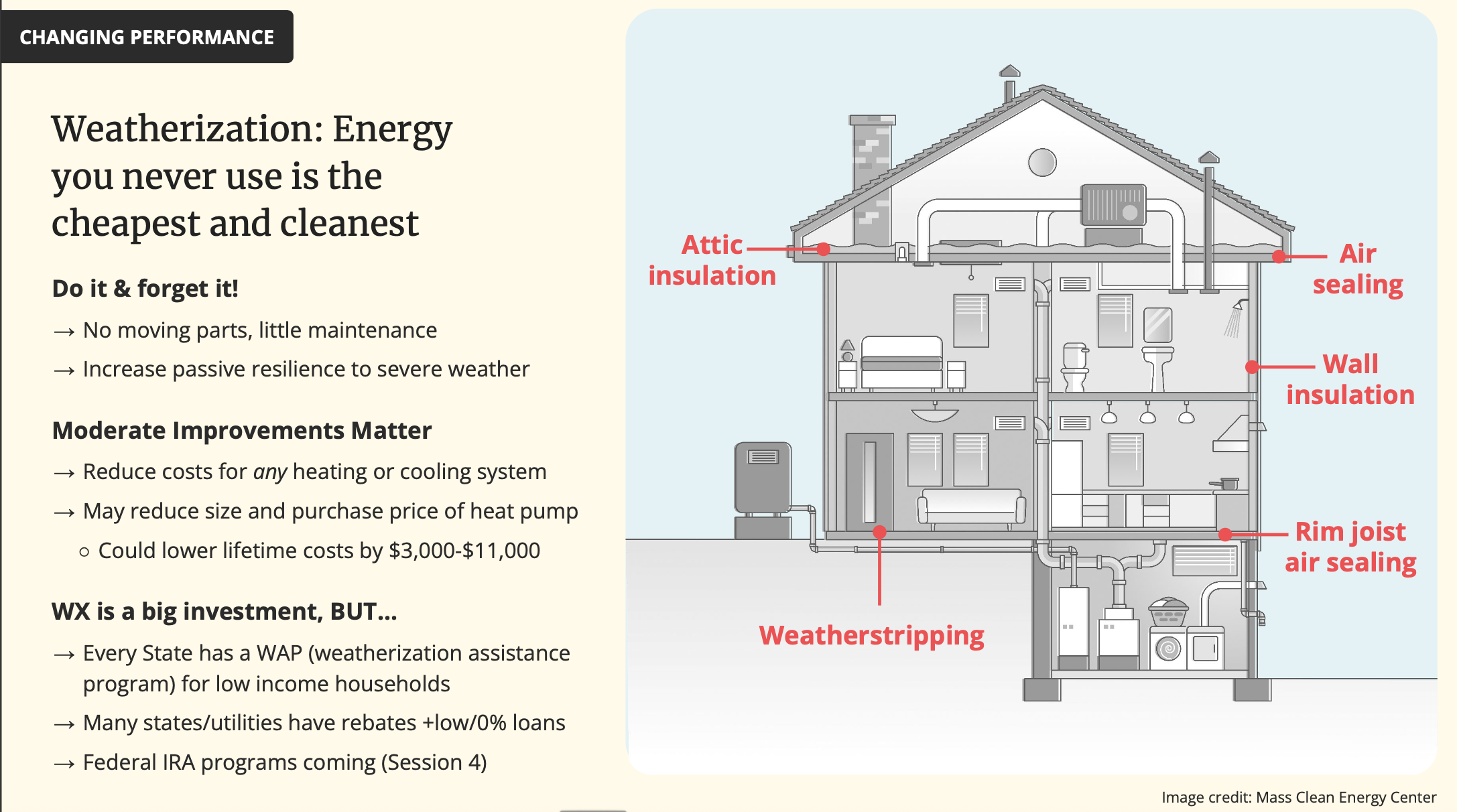
Review your House inspection reports
Our housing inspectation report – which we did after buying our house to attempt to avoid suprises. It had a number of recommentions which are listed below.
- Drainage is an issue in Toronto and in some cases there are very controlling local laws that state what you can and cannot do with your Gardens. We care because we have a finished basement, but we did buy at 100 meters over sea level and we are not near a river or lake. For us paying attention where the waters comes and where it goes matters for our basement.
Get an Energy Audit
This will turn your house into numbers which allow people to determine the airflow into and out of your house – the air literally cycles in and out of your home – unless it’s a very good and modern build.
In many places you can get your money back for Energy Audits – check both Federal and Provincial/Terrority energy saving or renovation programs.
For most Candian grants and rebates you need to start with an Energy report, before you can do the work.
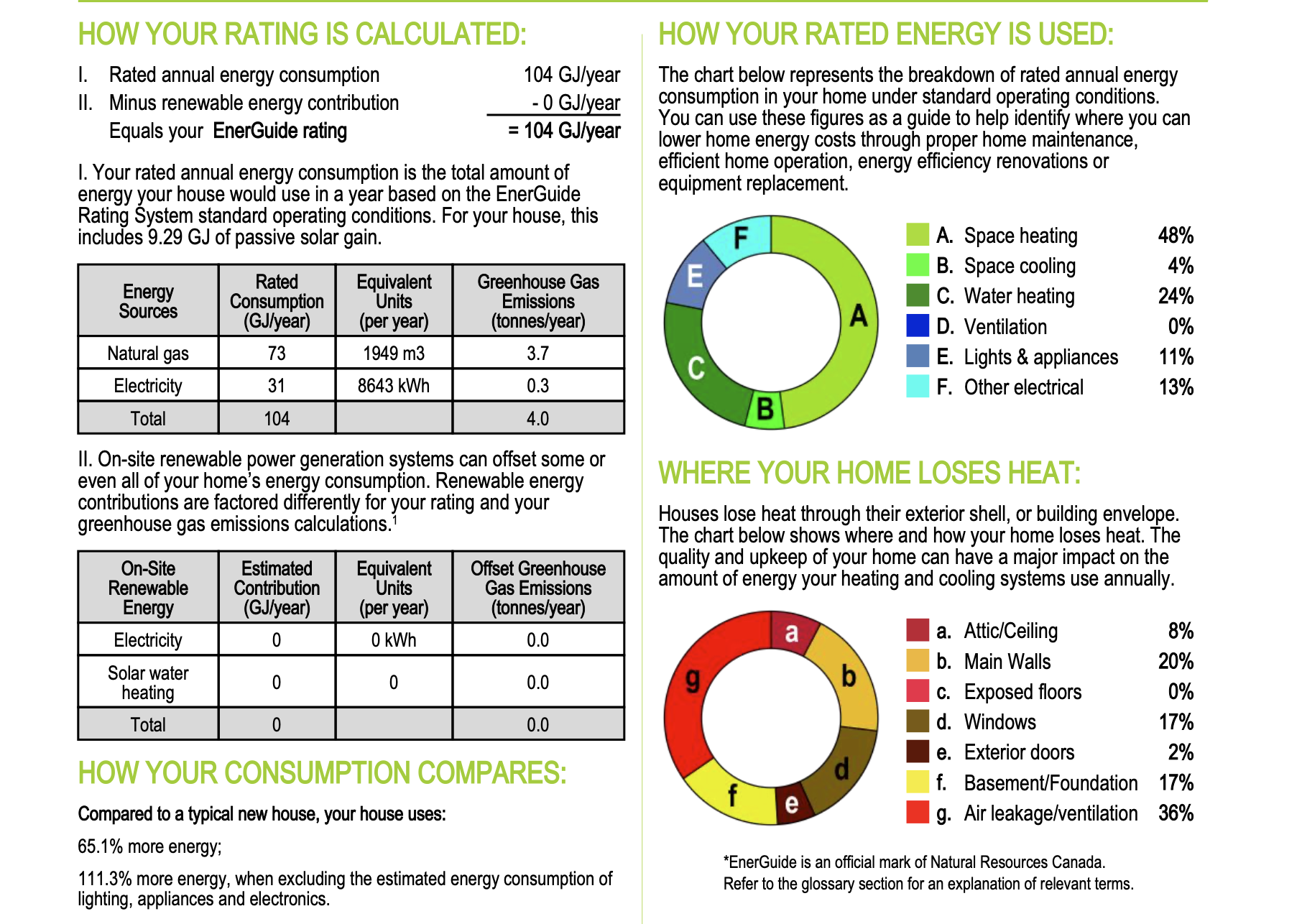
The major reccommendations that came out of it were:
- Perform air sealing
- Insulate Attic
- Upgrade Hot water System
- Upgrade heating system
The recommendations are needed for some Grant and Rebate programs
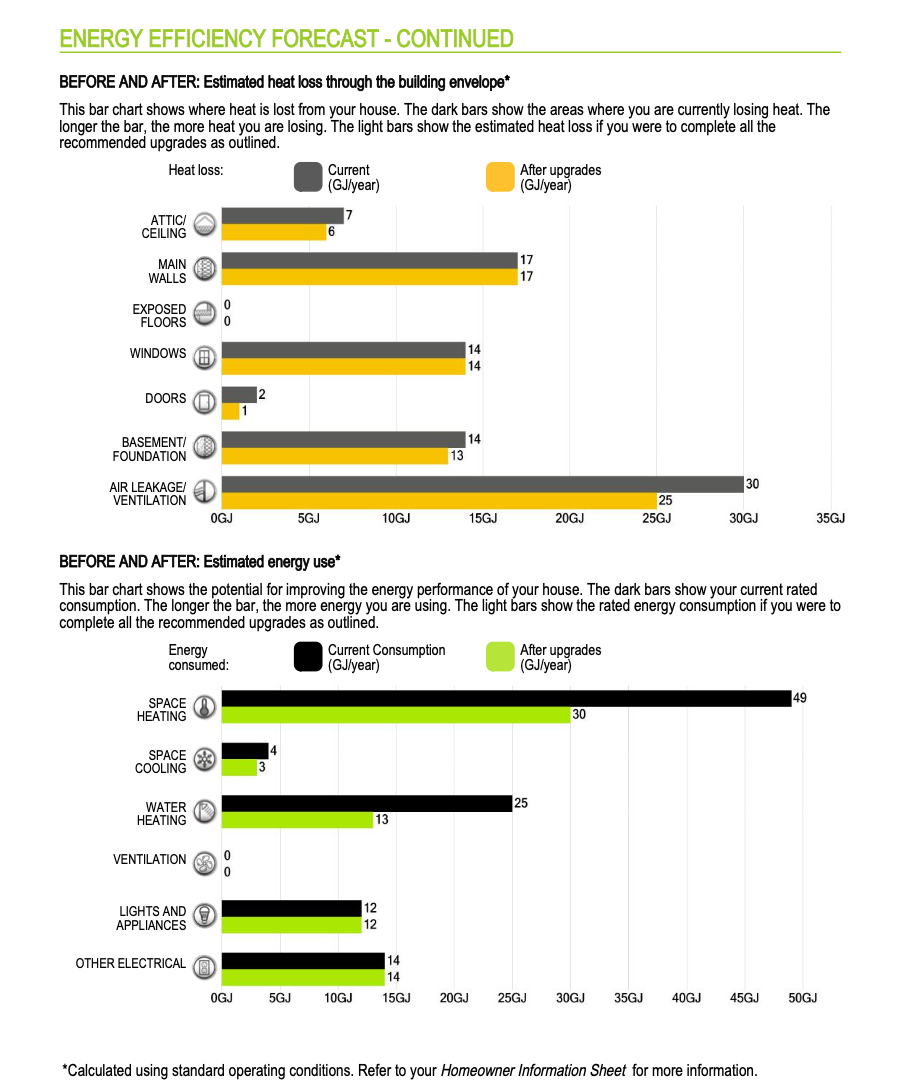
The actions we took:
- Engery saving
- Improve our Attic insulation from approx approx R20 to R60
- We have two roof sections – one was at R 7.9 and one at about R20, about 50% split between both. Both are at R60 now
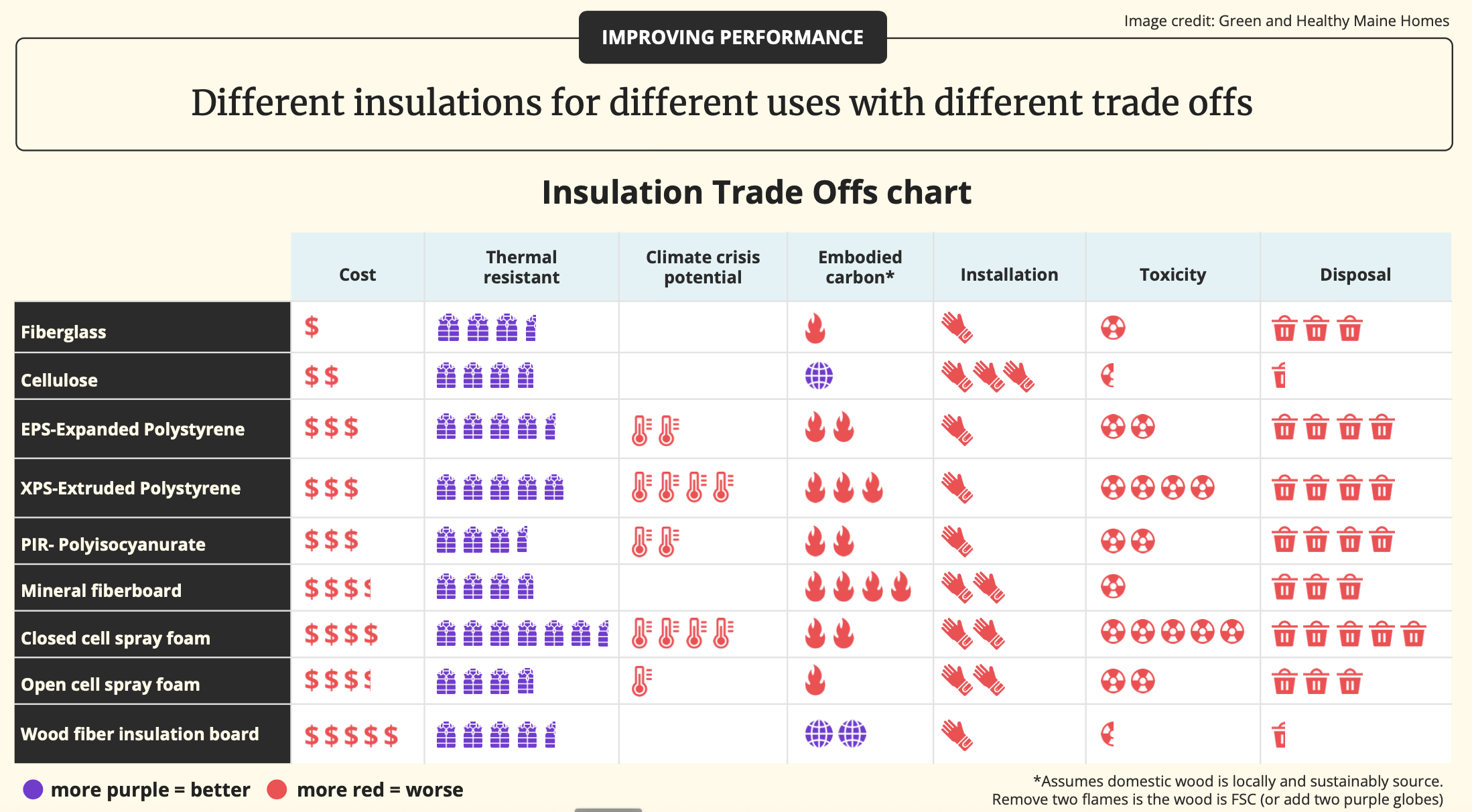
- The type of insulation or the material it is made from really matters
- Improve our Attic insulation from approx approx R20 to R60
- Blower Test and Gap Filling
- Someone comes in and tests the air pressure in your house and then attempts to find the gaps
- This was very disappointing for us and we reduced our airflow by only 3.6%
Post this work our Heat Loss Calculation dropped by 0.009819 GJ or 9,306.31 BTUH. That is already saving us money on our compared power bill, especially during winter.
Weather proofing
As most the predictions show we will likely have more water and Toronto has a drainage problem during storms. We made the following upgrades:
- Better Drainage
- To keep the water away from our house
- Backup sump pump (for our finished Basement) with Battery
- The one time you need the sump pump to work i.e. a storm is when it is the most likely time to lose power.
Further Areas that are important to consider
Windows – To replace is generally costly, so you may want to look at other options first e.g. Caulk around any Window Trim, consider Window Inserts, consider insulated curtains and blinds
Basement insulation – Seal any gaps with spray foam.
Doors – Weatherstrip and Sweeps
Insulate Electric Outlets / Receptacles / Sockets – This can reduce draft on outside walls.
AEROSEAL – Reduce Duct leakage, which improves your ability to cool your house and could save you money if you have an older duct work.
So you do all the above and something happens – you collect more Radon in your house.
From The Canada Health site:
“Radon is a radioactive gas that comes from the breakdown of uranium in soil and rock. It is invisible, odourless and tasteless. When radon is released from the ground into the outdoor air, it is diluted and is not a concern. However, in enclosed spaces, like homes, it can accumulate to high levels and become a risk to the health of you and your family.
Radon gas breaks down to form radioactive elements that can be inhaled into the lungs. In the lungs, radon continues to breakdown, creating radioactive particles that release small bursts of energy. This energy is absorbed by nearby lung tissue, damaging the lung cells. When cells are damaged, they have the potential to result in cancer when they reproduce.
Exposure to radon and tobacco use together can significantly increase your risk of lung cancer.”
You will find Radon in most if not all homes on this planet. Radon is the #1 cause of lung cancer in non-smokers.
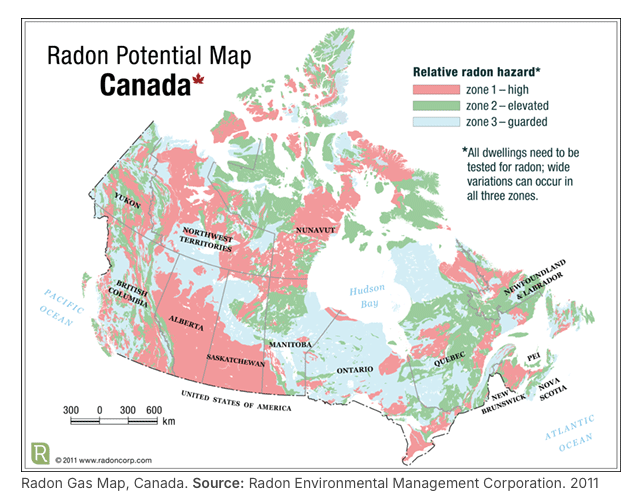
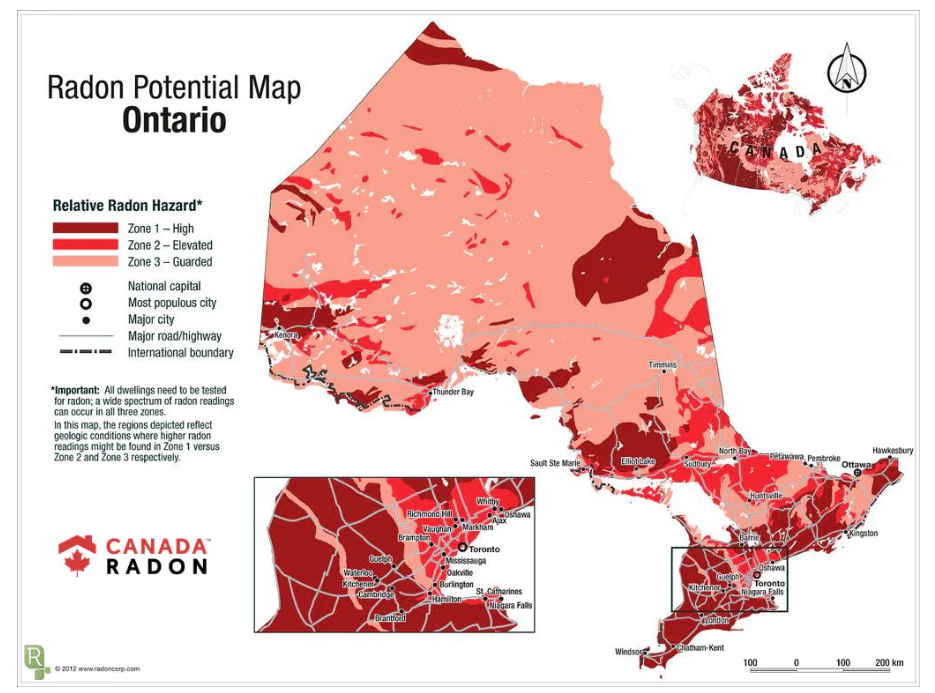
Broadly you want it to be as low as possible – its worth noting that Radon exists everywhere
What level is dangerous?
The Canadian guideline for radon is 200 becquerels per cubic metre (Bq/m³). Check this page in cases this changes
Does Radon increase or decrease for any reason?
Weather and Season both affect Radon levels – the more it rains the more it gets broken down. During Winter levels may increase at the same time you are spending more time in your house – soil mositure is a big factor and the weather affects it.
Testing for Radon
- Buy yourself a Radon Test Kit -> https://takeactiononradon.ca/test-for-radon/radon-test-kits/
- Hire a Professional
- Buy yourselve a device that tests it all the time
As this Radon levels change I want to be able to track them – especially during winter
I looked through a lot of devices – I wanted to make the data was protected, with a company that was looking at the wider atmosphere. This is 2025 so anything science orientated I did not want to be affected by what is happening in the USA i.e. the systematic destruction of science and truth.
Through this journy I found AirThings – A Norwegian company. I chose the Airthings 2960 View Plus – For me I thought paying attention to the air quality not just Radon would be useful for our Basement. I like the Mobile App. A couple weeks in – it takes a month for it to be accurate.
Mitigation
If you are above 200 becquerels per cubic metre (Bq/m³) – there are a lot of professionals who can help you bring it down to a safe level for you and your family. This science page gives you a couple options
 Eric Brooke's Blog