I took a pre-apprenticeship course in electrical work. Does this mean I am now a licensed electrician? Nope! That takes five years in Ontario, Canada working as an Apprentice. Consider this a side quest as I will head back to tech afterward.
Why Electrical?
Summary – Learn something new, it’s within the engineering space, adjacent to software, and we need to electrify everything going forward.
As part of my career break (from being a Tech Executive), I like to take a couple intense courses that will really dig into areas where my experience and knowledge are non-existent or light.
I chose electrical work because it is an extension of what I already know in technology, and there is often a crossover between hardware and software. Whilst I have built and repaired many computers, I wanted to go further down “the stack” into understanding power and electricity as I think these will help me in any roles that require knowledge of IoT, smart homes, and Climate Tech. It also gives me a better understanding of how my home and workplaces are supplied with electricity.
Over the last year, I have been reading about the science and engineering behind climate change. It is quite clear that if we wish to reduce our carbon exhaust into our planet’s climate, that electrical work will be a big part of that journey. For example, moving from natural gas and oil in favour of electricity i.e. heat pumps, electrical vehicles, electrical ranges.
When you take a career break, I find that you need moments or parts of it when you have a clear structure, and interact with people on a regular basis. My preference has been to be thrown into something, with people I would be unlikely meet any other way.

Which Course?
There were a bunch of Electrical courses available in Ontario, Canada. Most seemed to focus on theory, and I wanted to walk away from this course with knowledge certainly, but also real hands-on experience. I also wanted an instructor who was an effective communicator, and previously an electrician.
The Electrical course offered by Skill Trades College of Canada seemed a good fit. But is not cheap, both in money and time – it is three months every weekday in school and a bunch of homework. I went to the nearest campus (North York) and met Alfie, who showed me around. I was convinced and signed up there and then.
Previous knowledge
I was not a person who did DIY, so a LOT of the course was new, with relearning some maths and physics, and learning how to use tools well. My previous experience in electrical was limited to computer repairs.
What Did I Need?
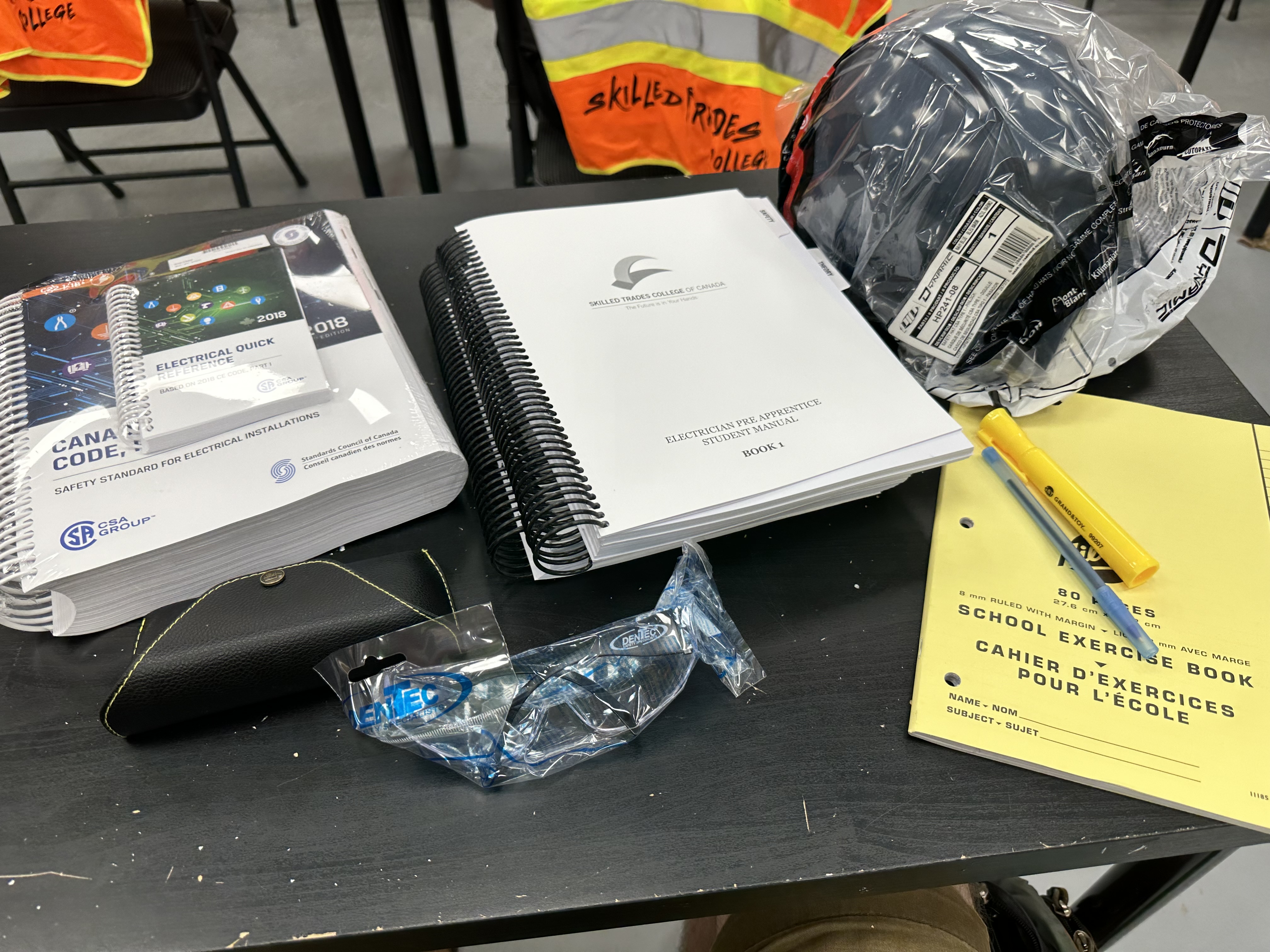
The course tuition pays for tools, a Backpack, a Helmet, and a safety vest. You only needed to buy your electrical safety boots and a scientific calculator (you cannot use your phone during exams or quizzes). I got myself a Casio fx-115ESPLS2 White Advanced Scientific Calculator with Natural Display. I would recommend a few other items:
- A permanent marker – to put your name on all the tools. The whole class has the same tools, it’s good to know which are yours.
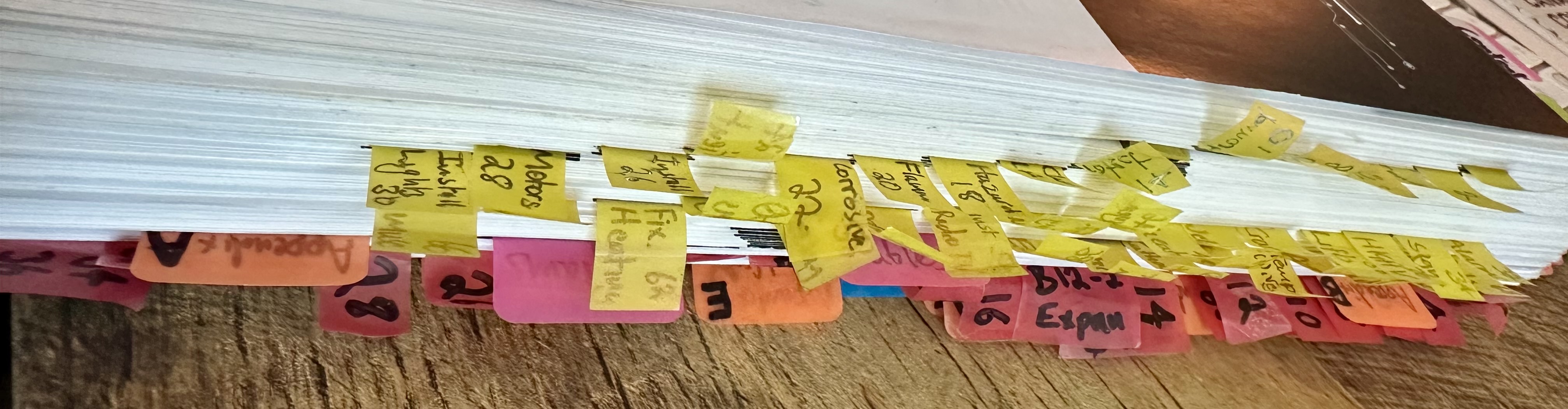
- Tabs to use on your paper copy of the Electrical Code. This will save you a LOT of time finding the right section, table diagram or page
- Sections – 43 – down the sides
- Diagram – on the top – 20
- Appendices – 14
- Appendix D – has extras for each of the above Sections
- A pack of band-aids, you will cut yourself
- Tweezers for splinters
- If you need prescription glasses you may want to get some prescription safety glasses. I found some at securovision
- Different colour pens or pencils will be needed for blueprints. You can now buy Erasable colour pencils!
- A ruler (with both imperial and metric measurements). This will really help with the prints. A stencil to help with drawing prints and keep things neat – thanks for the reminder Brian
- A big strong bag will be needed to carry your notebooks, code book, and notes – my Roots one lasted me a while but did break
- Some Magnets to magnetize the tools that are not yet magnetized

The course
It’s three months, every day in class starting at 8.30am and leaving about 3pm, with one 15 min break in the morning and 30 mins for lunch. Each day started with Electrical Theory, Electrical Code, Math, or a marked quiz/exam (which feeds into your final grade). Each day I would commute (Train and Bus) to school about 45 to 55 minutes there and back. The post-lunch time was mostly Labs (wiring different circuits, different devices, pipe bending, etc).
Who was studying with me?
There were people straight out of High School, one who was a Paralegal (but saw the end of that trade with AI), a Civil Engineer who wanted to know this field, people from construction, people who worked as electricians in other countries, and people finding their career. This class was very talented and diverse.
Overall what did I learn?
Tools of the Trade
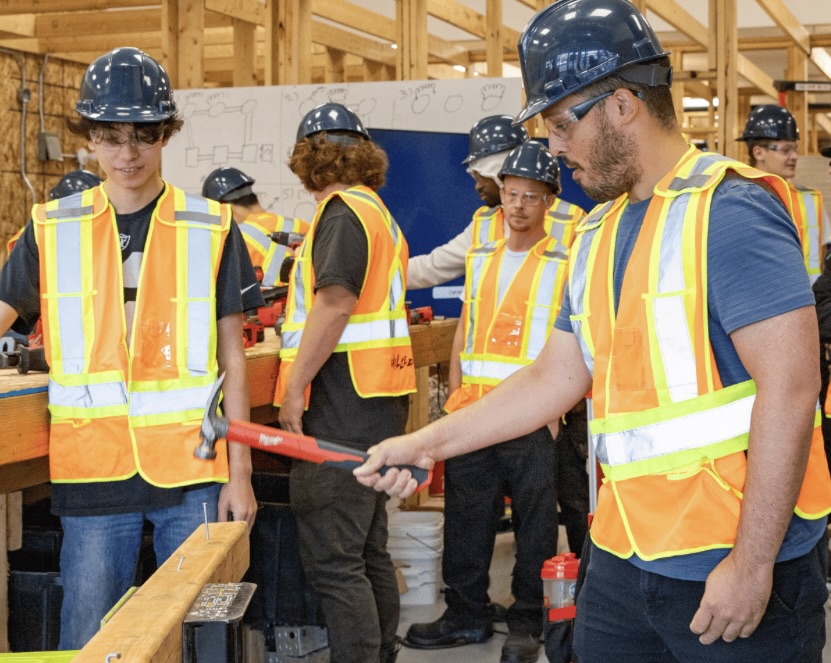
One of the advantages of having an instructor who is a veteran is you learn from their wisdom about how to use tools. Whether it be stripping wire, wiring up a receptacle, or a light, the time to do each task became much faster over three months of doing them again and again, and I lot of this was using the tools effectively and safely.
Residential Labs
Our practical installations started with what we would install in someone’s home/dwelling. For each lab, we would have to create a schematic, wiring diagram, and the actual physical implementation.
For the implementations we used:
- Cables – Multiconductor (AWG 14, AWG 12, AWG 10, AWG 8, 00) and Single wires (T90), Non-conducting and Armored sheaths, Copper and Aluminium
- Receptacles (Sockets) – 15, 15 split, 15 GFCI, 20 GFCI, 20, 30, 40, 50 – Amps
- Switches – Single Pole, 3 Way, and 4 Way
- Luminaries (Lights) – Recessed and not
- Extraction Fans
- Fire alarms
- Service mast (Complete Residential install)
- Doorbells
Most of the installations/Labs were done in many configurations i.e. where the power comes in would change, e.g. sometimes near the switch, sometimes through the luminaries housing, and sometimes near the receptacle. This built up our experience of the best approaches. Some who finished their labs early got Bonus Labs, which would make the configuration harder, and deeper thinking for the best way to flow the electricity through the installation.
For some of us who finished earlier, we got to support a complete house built by the Renovation students.


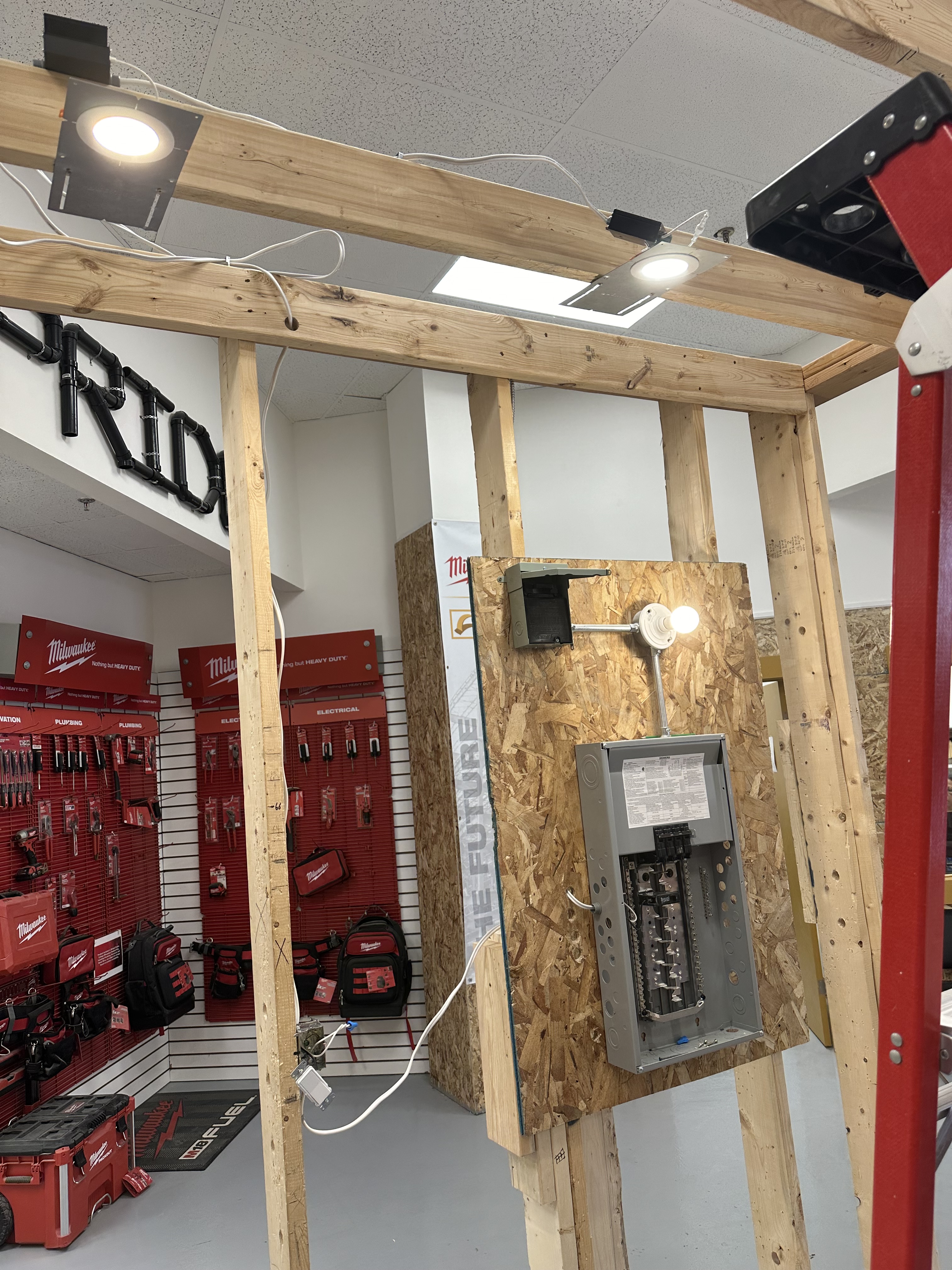

Commercial Labs
For commercial we used different wires, fished them (pulling a wire from one location to another either in pipes or in walls), bent multiple metal pipes, and heated and bent PVC pipes for the installation of Switches, Luminaries, and Receptacles.

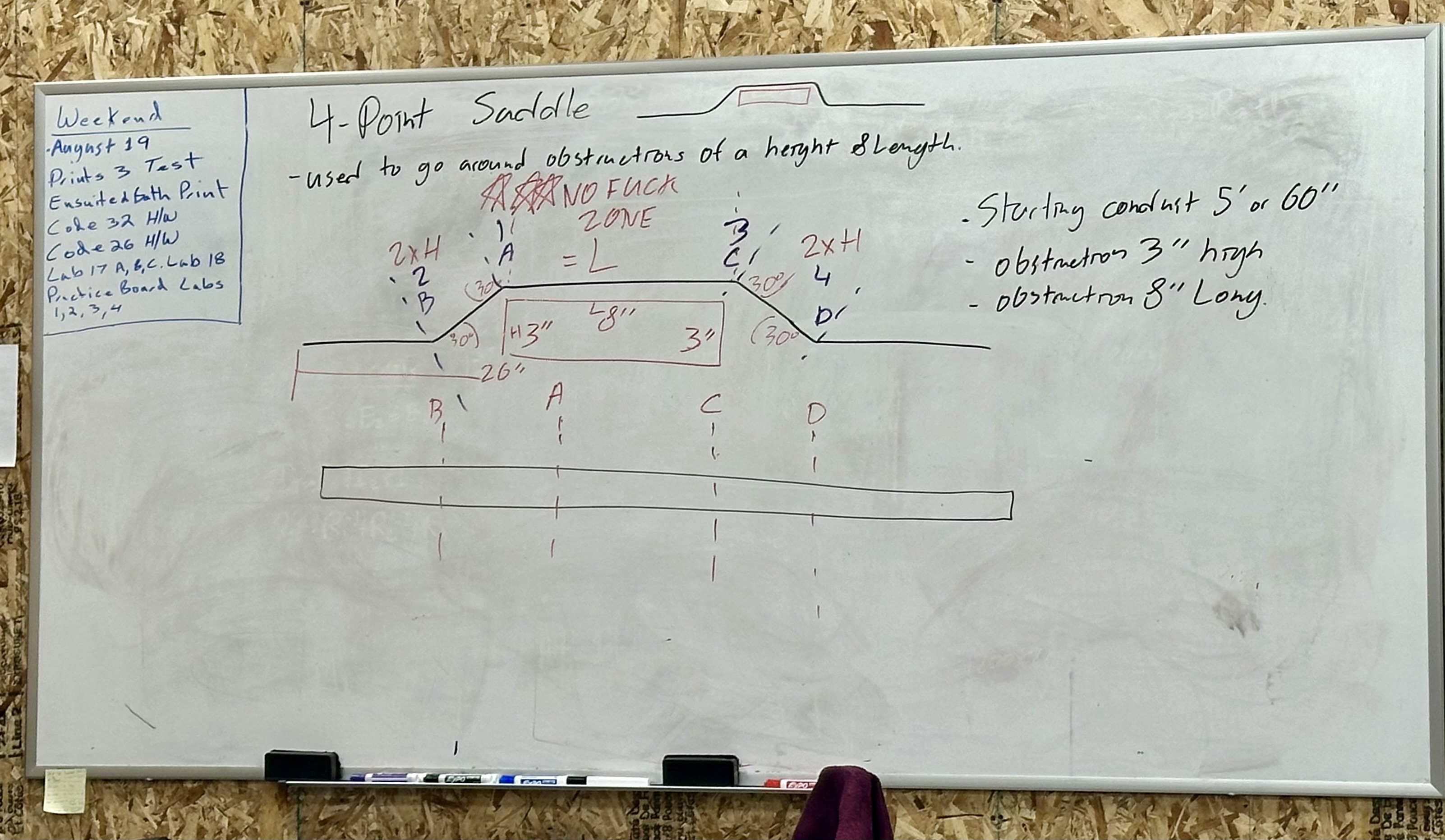

Electrical Theory
We learned (relearned) a lot of math and physics. The topics we learned, did marked assignments and exams for included:
- Atomic structure,
- Static electricity,
- Magnetism,
- Electrical qualities,
- Ohm’s Law,
- Resistors,
- Serial circuits,
- Parallel circuits,
- Combination circuits,
- Measuring instruments,
- Electrical Generation (Spin, Solar, Thermal, Chemistry, Pressure, etc)
- Batteries,
- Single-phase transformers.
It’s worth mentioning there was some incredible support for those who found Math more of a challenge. Our instructor walked the whole way through each problem, in some cases multiple times.

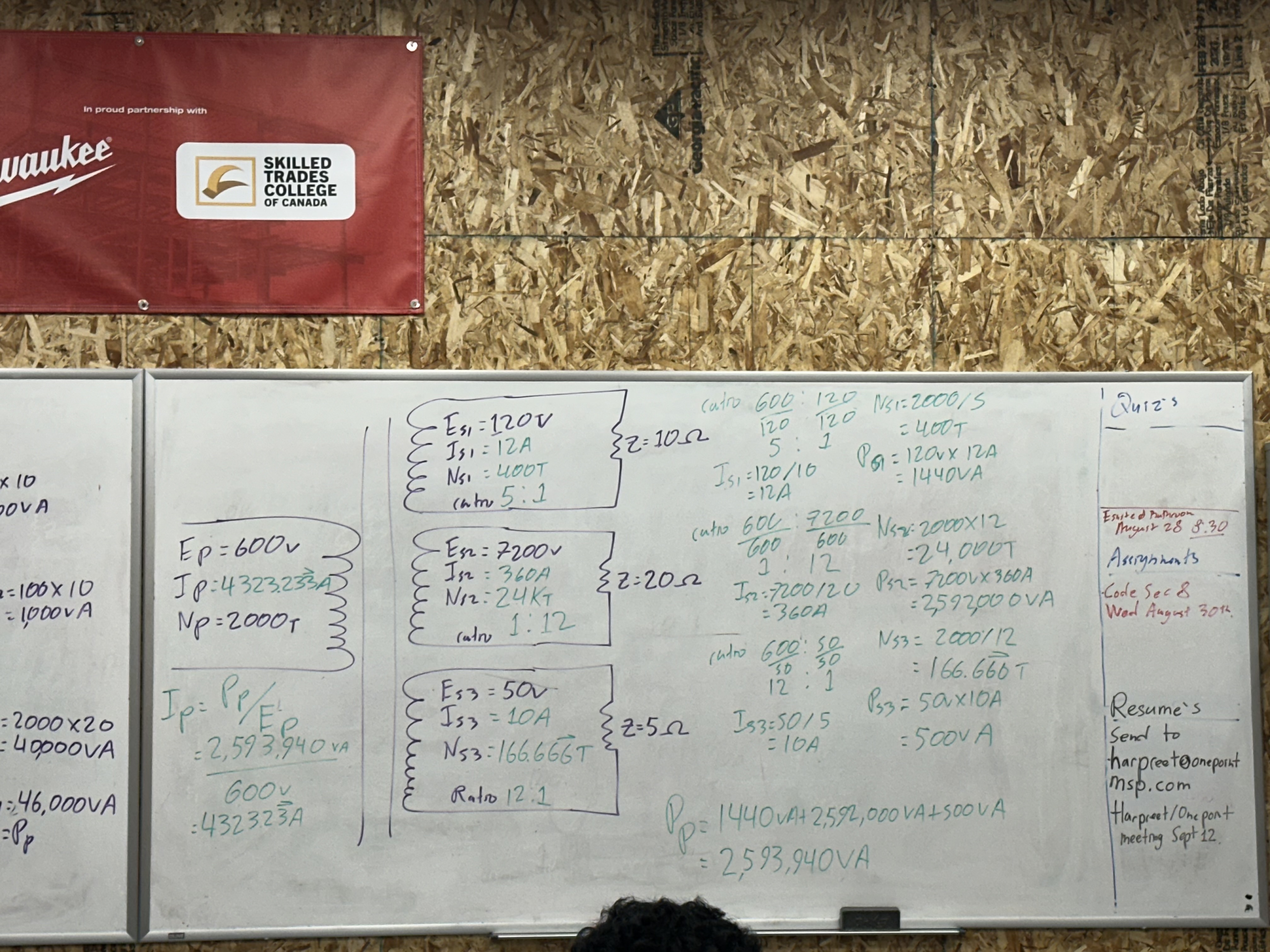
Safety
Most Trades are often carried out in places where there are dangerous materials or powerful devices and then of course electricity. These topics helped us be mindful and protected both ourselves and our co-workers.
The courses included were:
- First Aid Training,
- 2105 WHMIS,
- Back Care,
- Heavy Tools,
- Materials handling,
- Personal protective equipment (PPE),
- Electrical safety,
- Lockout and Tagging
Canadian Electrical Code examined
It’s important that there is a good, pragmatic, and safe standard for our electrical work to protect people who install and repair as well as those who live and work around electricity. This code is updated usually every three years and works in conjunction with Provincial Codes (i.e. Ontario) as well as other Construction codes.
The Canadian Electric Code, Part 1 – codebook is a beast – it has 741 pages and costs over $180 – even if it’s a pdf or print (The school provides a copy). We covered most of the bulk of the code book through training, reviews, assignments, and exams.
Sections covered in great detail were the following associated Tables, Diagrams, and Appendices:
- 0 – Object, scope, definations
- 2 – General Rules
- 4 – Conductors
- 6 – Services and service equipment
- 8 – Circuit Loading and demand factors
- 10 – Grounding and bonding
- 12 – Wiring methods
- 14 – Protection and control
- 26 – Installation of electrical equipment
- 30 – Installation of Lighting equipment
- 32 – Fire alarm systems, smoke and carbon monoxide alarms and fire pumps
- 68 – Pools, tubs and spas
Areas I dug into and learned in addition:
- 56 – Optical Fiber cables
- 62 – Fixed Electric Heating Systems,
- 64 – Renewable energy systems
- 86 – Electric Vehicle Charging systems
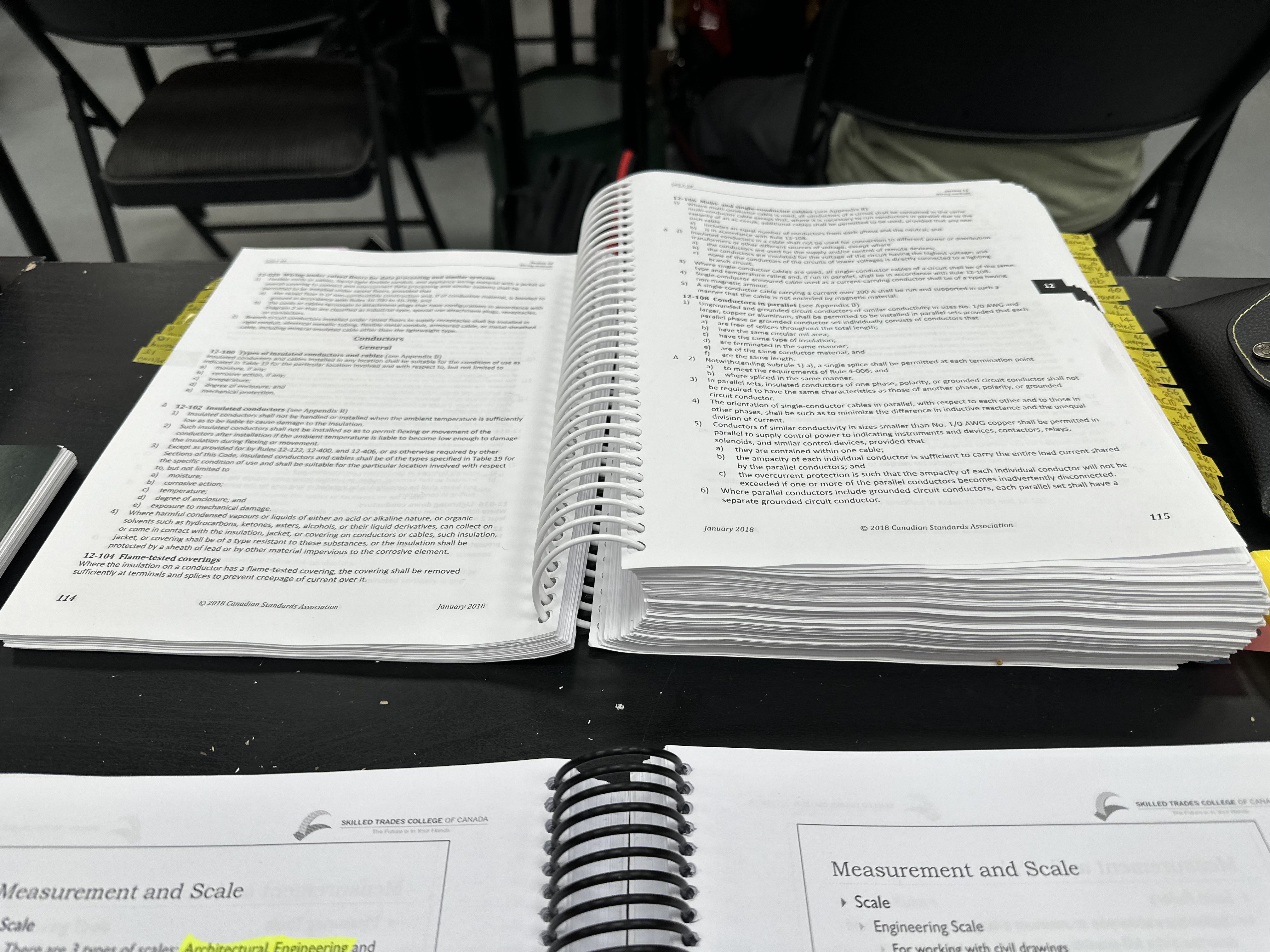
There are also a couple of important organisations that we got to learn about, when it comes to standards and inspections:
- CSA Group – Canadian Standards Association
- ESA – Electrical Safety Authority (Ontario, Canada)
- ULC – Underwriters Laboratories of Canada
- SCC – Standards Council of Canada in Canada
- ANSI – American National Standards Institute
- IEEE – Institue of Electrical and Electronics Engineers
Prints
We learned and drew up prints for all rooms in a large house – to note where things would be installed where the power was coming from and how much would be needed. These interact with the standards set down in the Electrical Codes and Construction codes, for example how many receptacles you must install in a room, differ by room type and what you should install in terms of Amps.


Certificates
People are rewarded with Certificates if they pass the practical work, the Quizzes, and Exams. Certificates received:
- WHMIS 2015,
- First Aid,
- Lockouts & Tags,
- Working at Heights
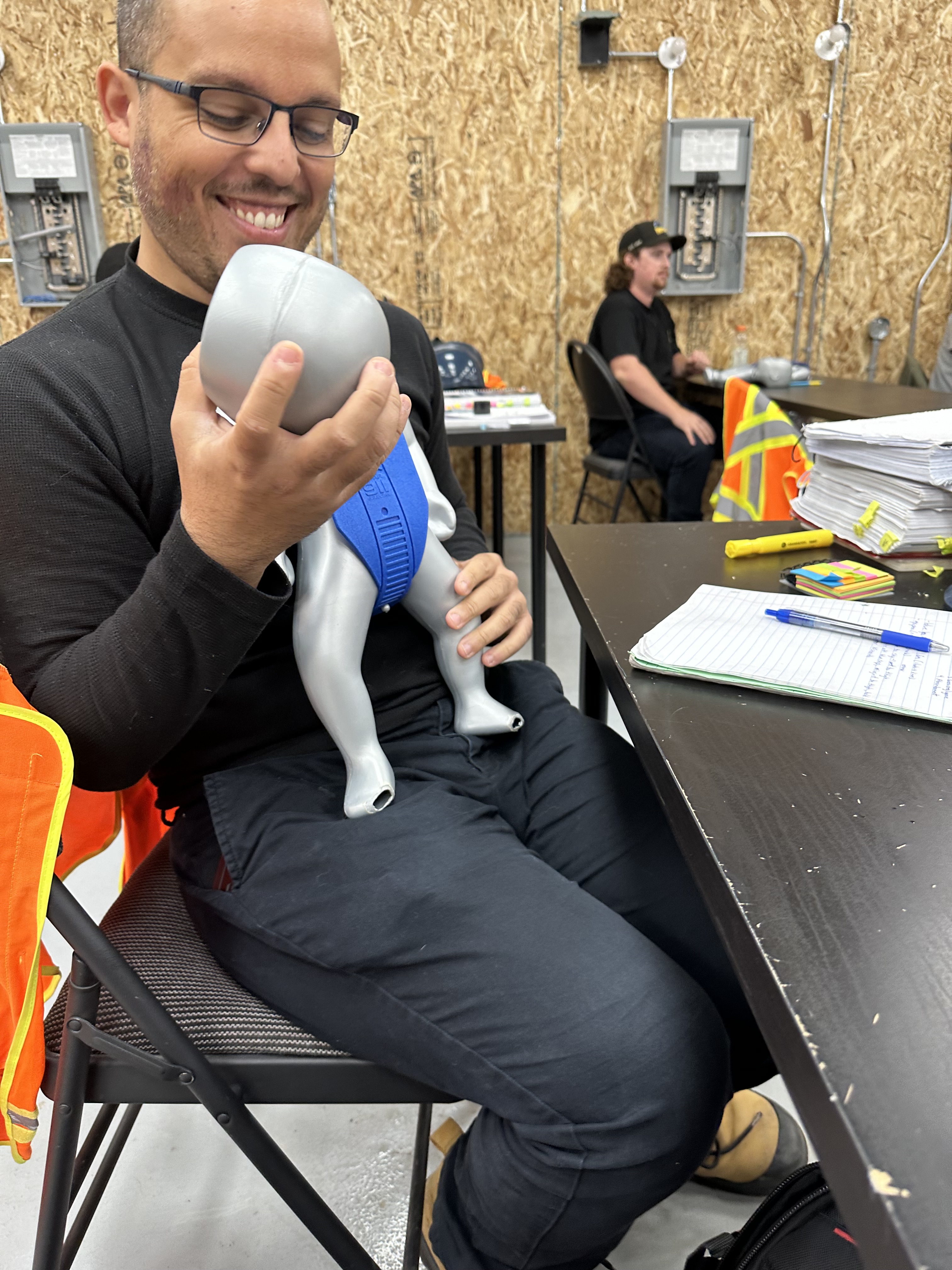
Trades Person Games
Towards the end of the course, we had some fun. We were broken up into four teams. Our Team was Three Range Pirates, we played lots of fun games, some using our knowledge and skills built up throughout the course. It was a close run between two teams – our rivals – The Big One and we were ahead, then behind, and finally tied. In the end, our Team won out but only just – an honour Will and Dan.
The Instruction
It was Outstanding ( I say this as a fellow Instructor/Professor). We had an instructor named Stefano. He was incredibly patient and pumped energy into the very dry things i.e. The Canadian Electrical Code. He foreshadowed topics so we knew what was coming, we repeated a lot of things and he would walk through every step without missing anything. He gave us assignments for each area to be marked and be a part of our final grade. And then he did reviews – in some cases, we were taught the same thing 2-4 times depending on the complexity – but he did it with different examples and sometimes different perspectives. What he taught us is now embedded in my brain.
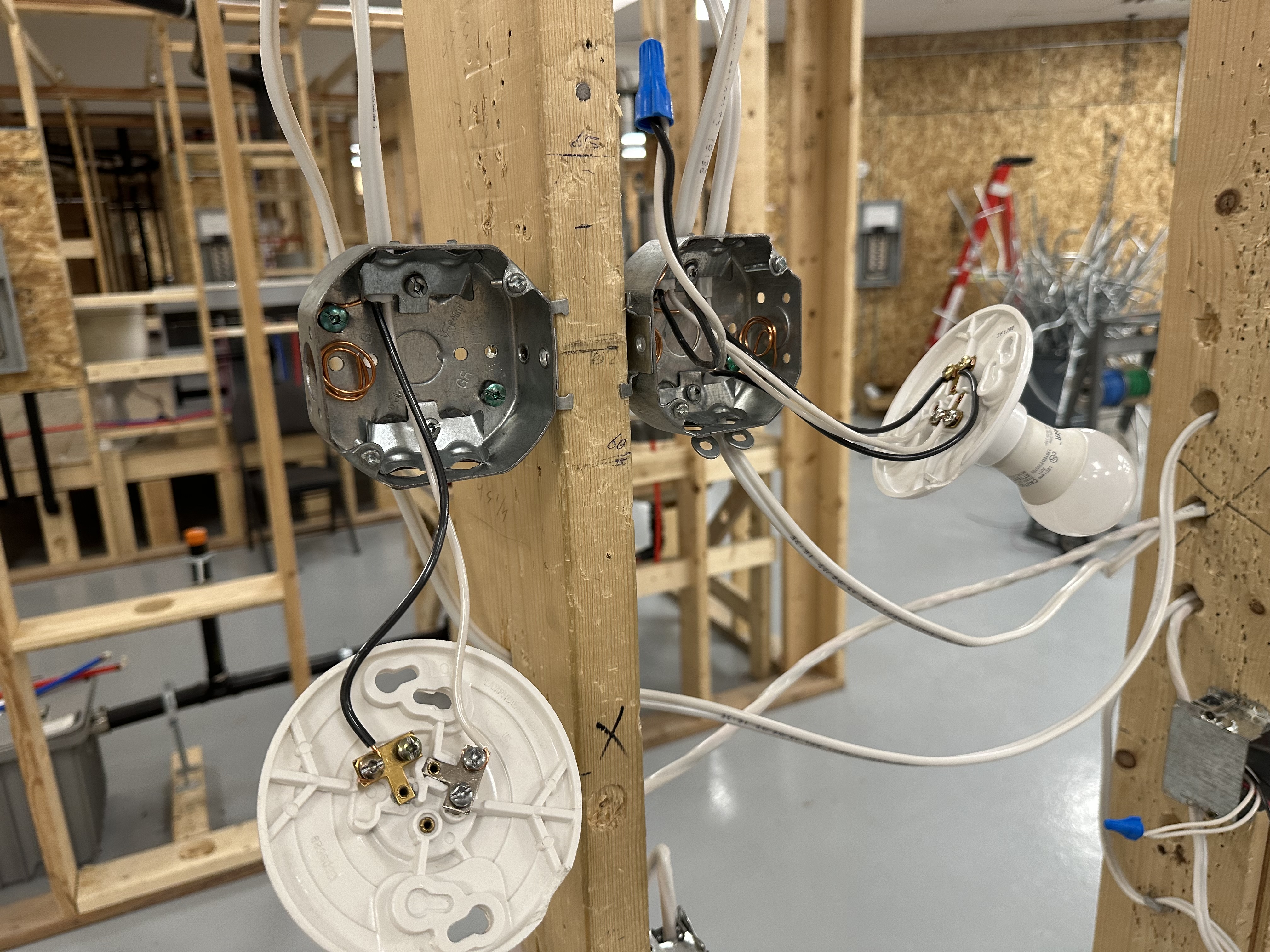
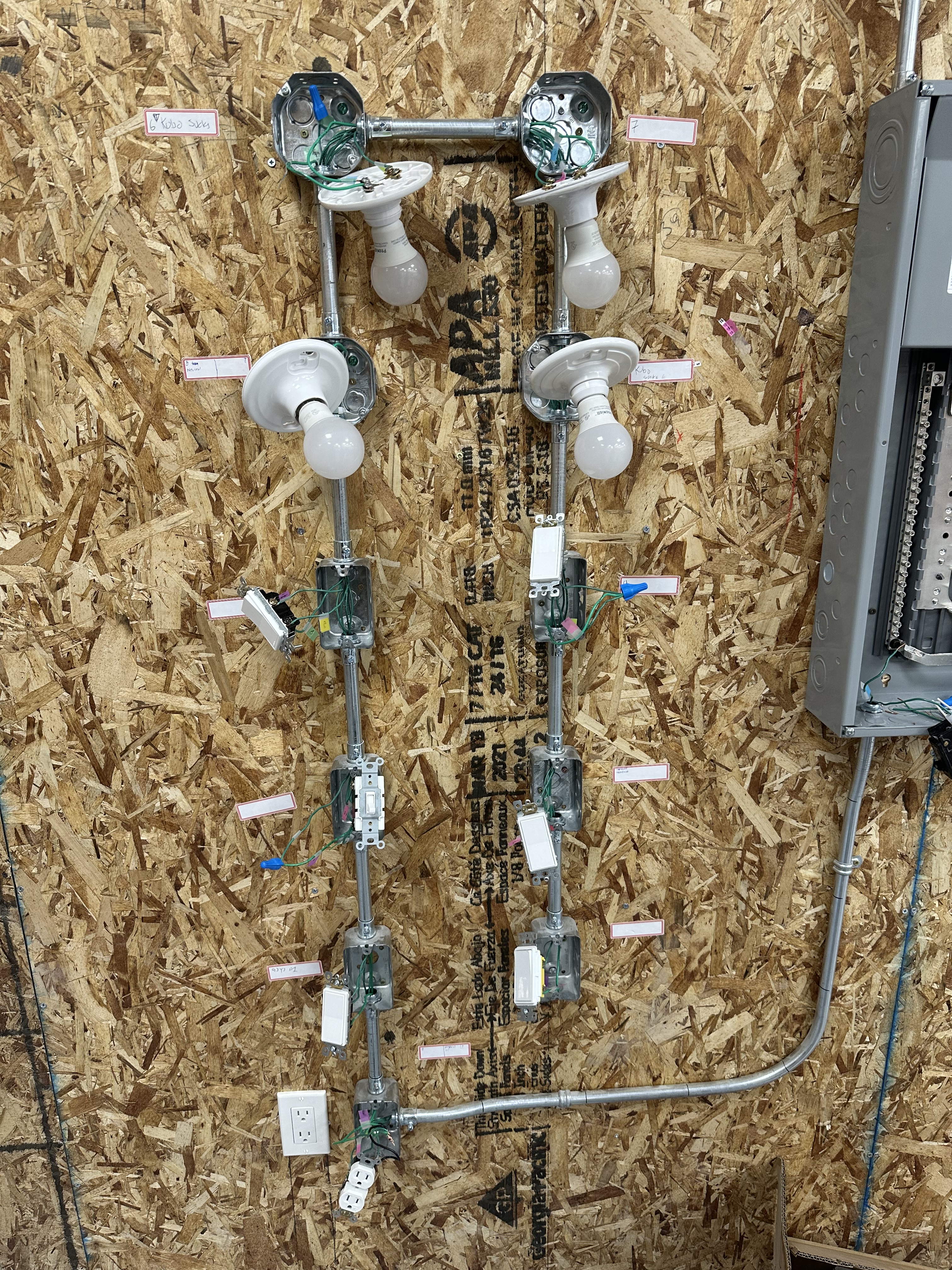
Stefano’s goal was not to just teach us the minimal – if you got ahead, he would have a bonus lab for us to wire – like the base was 40 Labs, but I walked away doing about 60 Labs. He helped us upgrade our problem-solving skills. Here is one example where every wire was the same colour and we had to figure out how to wire it and make it work – this is the end result.
Was it worth it?

Yes. I stepped away from this course with a lot of knowledge and practical experience, including the ability to wire a house and follow a commercial blueprint. The program claims that the course brings you up to the equivalent of a second-year apprentice.
My goal is not to become an electrician. On an apprentice salary, it takes five years in Ontario, when I can work in Tech for multiple more. Also, see below for more of the reasons.
Working with my hands for three months was amazing, refreshing my knowledge in Math and Physics reminded me how much I love them.
If you have time off or are taking a career break I would highly recommend taking some Trade Skills.
Job Hunting for those who want to become electricians
Throughout the course, our Instructor told us about their eight years in the electrical trade. We learned about Union and non-union work. The Union membership requires that you have certificates in High School Math and Physics – if you don’t have you can take the courses and exams online. We had the opportunity for our resumes to be reviewed. We also got introduced to a recruiter (who had several hundred students whom they were looking to place. We also were introduced to an apprentice job site.
The Future in Canada for electrical work
I would say overall it’s bright. Canada needs to build a lot of places to live. This being 2023 is an uncertain time for any economy around the globe. Interest rates are high to counter inflation (that we created during COVID-19)and thus construction is lower than usual. But when the economy recovers I have no doubt there will be a strong need for electricians.
If Canada takes climate change seriously we also have a lot of work to transform our electrical grid, create a lot of additional electricity, and update all of our home appliances from Gas and Oil. This will depend a lot on which Political Party is in power and how well the economy is doing. If this work actually happens, then we will need a lot more electricians and be fast in taking advantage of many new technologies i.e. Electric vehicles, and some old technologies i.e. heat pumps.
I can also see some tough oncoming problems ahead for the electrical trade, these are all personal opinions:
- It appears there are not enough electricians to do the work under current regulations. Many electricians are baby boomers who will shortly retire- they often do this earlier as most trades are hard on the body.
- It takes five years full-time to qualify as an electrician in Ontario as a “Journeyman”, and the wages do not compete with many other careers, as you are an apprentice. You have a fixed number of hours working, which takes about five years in Ontario.
- Different Provinces have different required hours to become a licensed electrician. It takes too long to train them (5 years in Ontario or 4 Years in Alberta/British Columbia/Manitoba) and the hours vary according to Province. Why? Should they not be the same, or is the training better in Alberta? Being an Apprentice limits the amount of money you can earn. Why does Ontario want to hold people back, because they are cheaper?
- If a pre-apprenticeship program of three months can bring you up to the equivalent of two years as an on-the-job apprentice, why don’t we encourage all apprentices to go through a scheme that is designed to speed up the process to be a licensed electrician?
- Each Journeyman can only have ONE apprentice, which limits the growth of the trade at a time when we have a massive transformation to do on the grid, in electrical generation, and in our homes.
- The code books – Electric code and construction green book are not accessible to read, they are written like laws.
- The US will likely encourage many to move there as they are short of about 118,000 electricians.
- It feels like the relevant parties got together to build a system to support the qualification journey of someone straight out of High School. The system is not built for mature students entering Trades.
Government at both Federal and Provincial, Trade Unions, Trade Associations, and governments will need to make some big changes to create enough electricians and modernize the training process so it does not take five years. It appears does not need to – for example:
- This course allows graduates to learn the knowledge of a second-year apprentice but does not reduce the time required as an apprentice.
- Multiple Provinces only require four years not five
- Many electricians are not trained on how to train, mentor, or coach their apprentices. If they were could this be sped up?
- Many apprentices are used for mundane tasks such as wire stripping, getting coffee, and removing trash.
Apprenticeships are one way to train electricians, others should be explored to help the trade be more accessible to people of all ages and skills.
The ratio for the number of apprenticeships will need to increase per Journeyman. Electricians, who are immigrants will need a good education system approach to get them qualified for Canadian work.
 Eric Brooke's Blog
1 Comment