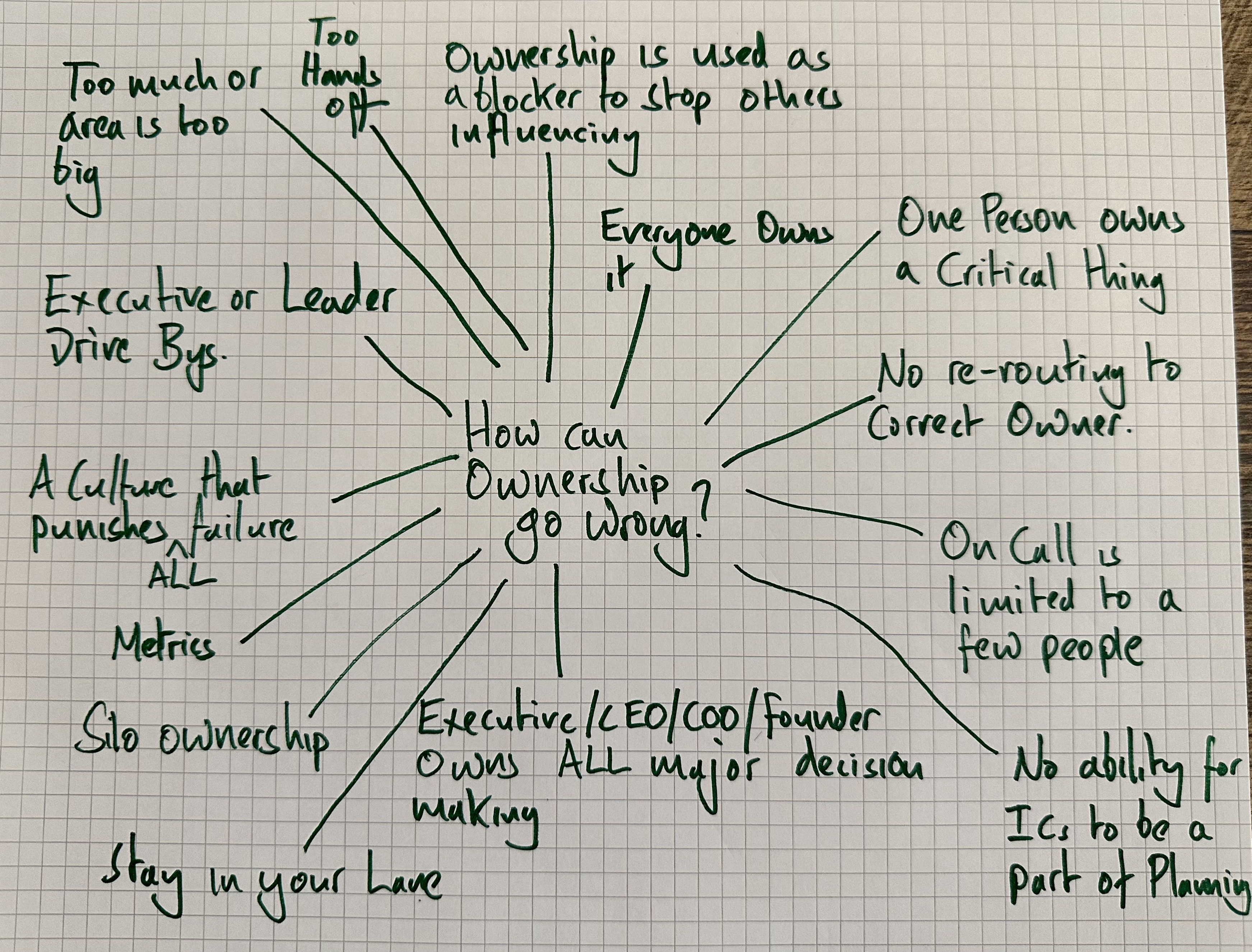
This is a five-part set of blog posts on Ownership. The first you can find here.
No approach is perfect, most things can be done wrong with unintentional consequences. I feel it’s important to explore both sides of a perspective.
There is a noticeable difference in language between bootstrapped startups, VC startups, and Private Equity Startups – which likely reflects the culture and intention of the Board, the CEO, and the Executive. The financial model for the organization will impact culture, language, and how you measure things.
Below I will share some anti-patterns to look for. For me an anti-pattern is something that merits a deeper look, it does not mean that it is being done wrong, as the context of the situation may give you no choice. They are the kinds of things you should have a plan to deal with when the time comes. It may be a simple one-line plan, such as “When we have an extra headcount, this is the most important area into which we need to add people”. And when you have some slack in your schedule, you can build a more detailed plan.
Note: always stay curious when looking for the cause, this will help you get to the root cause and not just focus on the symptoms.
Index
- One person owns a critical process, system, stack, domain, or architecture
- On call is limited to a few people
- Executive/CEO/COO/Founder owns all major decision making
- Ownership is used as a blocker to stop others influencing
- A culture that punishes all failure
- Silo ownership
- Drive-BysExecutive or Leader Drive Bys
- No re-routing to the correct owner
- Too much or area is too big
- Everyone owns it e.g. Security or Culture
- No ability for Individual Contributors(IC) to share their ideas or areas of passion to align
- “Stay in your lane”
- Over-focusing on specific metrics
- Too hands off
- Surprise Corporate Initiatives
One person owns a critical process, system, stack, domain, or architecture
If it’s all in that one person’s head, which means you lose access to it if they are on leave or are unreachable (sometimes known as tribal knowledge) or leave the organization. Or that person never takes a vacation and will burn out. This happens a lot in early startups
- Possible symptoms
- Could they be a Bottleneck or restrict decision making and delivery
- This could lead to burnout, do they take time off or take holidays?
- This could lead to a mono view, isolation, and lack of diversity of thought. Can make future adaption or change difficult
- If there is no documentation or runbooks,
- Incidents take longer to fix
- Brilliant Jerk – Is the one with a lot of key critical knowledge someone that most people fear because, while they may be brilliant, but they treat others with a lack of respect.
- Possible solutions
- Small company – In small companies the reality is that there may not be a choice. Consider what growth looks like here and how you can get to a place where this is not the case.
- Encourage them to start teaching others how the system works
- Consider who could be the shadow to the individual or hire a peer (maybe the start of a team), and help the the individual to have time to create documentation (even a video may be helpful to get this started)
- Medium Company – Consider how you build out shared understanding, and what supports can be added e.g. documentation, a team? onboarding, and presentations. Also, consider how you label this information so it can easily be found by others. Consider forming a dictionary for the organization.
- Imposter Syndrome could play a part here, in that someone could be scared to give something they know away, in fear that they may not be able to learn something else or that their value is reduced. Be curious and not judgmental to your approach here
- The “hero” – In most startups I have worked there is someone who owns a critical system and they are doing too much for the organization and may be burning through themselves. They may be used as a controlling mechanism on others, or they may not see anyone else as good enough to do this work. Consider how you help them find a better balance, i.e. hire a peer or become that peer. Understand their motivations and how you help them and the organization have a better balance
- Small company – In small companies the reality is that there may not be a choice. Consider what growth looks like here and how you can get to a place where this is not the case.
On-call is limited to a few people
Ownership does not just work 9 to 5, if you plan for revenue outside of that window you have to consider how you will support customers in that time window.
- Possible symptoms
- If your executive and key senior people do all the rotations, this can lead to too much focus on the here and the now and not the future of the department
- This could lead to Burnout for your more experienced people, especially if there is a lack of documentation and Runbooks
- It could stop leaders from thinking strategically (further and wider) because they are stuck in tactical thinking (past and present) which could affect forward planning for rounds of funding
- Possible solution
- For early-stage startups – This can be the norm. Consider how you build out of it – not just with people but the number of tech stacks and processes you have to support that are different – context switching can be hard.
- Consider using metrics e.g. DORA to pay attention to Quality and Incidents
- Everyone who is able, shares On Call; preferably not your head of department. The department head should assist by giving the team the time they need to fix discovered problems (i.e. managing the Executive) and translate the technical language into business language. They should also support the Incident Commander by removing obstacles so that they, and their team, can focus on resolving the incident.
- Create a system that you review on a regular basis, that fits your team and systems
- Create run books e.g. if this goes wrong, try this
- Figure out what happens when people take holidays or need time of for health, parental leave etc
- Survey people to discover what more can be done
Executive/CEO/COO/Founder owns all major decision making
The point of scaling is to solve a bigger problem or do it faster or make more money, and bring in people who can share the load. Part of scaling as a leader is about delegating so you can think further and maybe deeper.
- Possible symptoms
- Everyone not on the Executive is a follower (due to lack of ability or experience in decision-making) which could reduce the opportunities for leaders to emerge from all levels
- A lack of creativity and flexibility in problem solving
- A lack of new leaders emerging, because the top person makes all the decisions and no one else learns to
- Retention at leadership levels – What is the point of being a Director or Manager if it is to just follow orders? This transforms leading to waiting because all decisions bottleneck behind the top person, which could lead to retention issues for those that are capable.
- A brittle organization which does not adapt to external or changes fast enough
- Everyone is a follower and not proactive
- People could become sycophantic and only recruit more sycophantic
- Possible solution
- If you – Learn to delegate and agree how you should communicate what is going on
- Limit the number of things that the Executive can put forward in annual planning. The rest is to be determined by Managers closer to the ground
- Let Directors and Managers and ICs have a voice in Long term Planning and have space to come to reasonable conclusions.
- Devolve/Delegate ownership to all levels depending on capability not title
- Explore what building consensus looks like at your organisation
- Each of the executives talks about what they consider in their realm for making decisions, this can highlight areas to dig into. Consider doing this for your management team
Ownership is used as a blocker to stop others influencing
This is often a coaching opportunity to help the person understand what they are doing and the cost to others and the culture. Sometimes it is necessary due to urgency and dependencies then the coaching opportunity is one about communicating the why.
- Possible symptoms
- Controlling – An owner is more judgmental than curious and values their opinion above all others and consequently does not listen or take time to understand other peoples’ perspectives
- The owner becomes a bottleneck to all decisions in this space
- The owner overreacts when receiving feedback
- Possible solutions
- Challenge the owner to consider how they can educate others and build shared understanding across stakeholders
- Have leadership development training for all owners, including rules of the road for Owners
- Have good coaching and mentoring setup for all owners
A culture that punishes all failure
As opposed to a culture that allows a person to learn from their mistakes. As with many things, there is a balance here. Consider how the organization is helping and or hindering. If everyone is scared of failing, you are unlikely, for most, to get the best out of them.
There is often wisdom to be found in failure and the vast amount of people learn more from their failures than they do from their successes.
- Possible symptoms
- An owner is told that they have failed in public or they are told in private and the “teller off” then tells everyone behind the scenes what they did – gossip and toxic
- An owner has their area of ownership removed without any opportunity to correct
- The focus is on blame or finding a “scapegoat” rather than understanding the root cause
- People are often fired
- Possible solution
- Be curious and not judgmental
- Understand the system and see if that failed the individual
- Give the opportunity for owners to dig in and understand the root cause of a failure. If you are their leader buy them time to do a good enough investigation
- Leaders be vulnerable about failure – starts with the CEO
- Have blameless retros and post mortem for key incidents, regular retrospectives for teams or projects
- Encourage people to speak up when they think something is wrong and give them time to help with a solution – If they don’t consider conflict resolution training and using a psychometric i.e. TKI
- Consider, has you or the organization underfunded this area?
- Be good at setting clear expectations
- Don’t makeup numbers for budgets (consider a ground-up way of creating estimates so that everyone better understands the numbers). Check them with the people who are responsible for delivering them.
- Create tight feedback loops, so people can learn as they go – do not wait for annual performance reviews.
Silo ownership
This is natural that people focus on their silo(s). As an organization scales you will have more stakeholders who care about what you are doing. Consider how you scale yourself and your team as the need for sharing becomes increased.
- Possible symptoms
- People are more concerned with whose territory the thing is in, rather than who is affected by changes in this area
- This could be between departments or within departments or even between teams
- Possible solutions
- Leaders talk to each and consider how they do better
- Setup a group with key stakeholders, so all can be part of the solution
- A culture of support or empowerment and it considered anti to the culture to remove power from other departments and teams
- Find projects that encourage groups to work together
- If needed get a neutral party to faciltate
- Don’t ignore relationship issues
- Maybe create Service Level Agreements
- Consider how you educate others about what you are doing
Executive or Leader Drive Bys
Some good posts on Drive By – Drive-by management – Why we should avoid it and Don’t be a Drive-by Boss
- Possible symptoms
- No agreement on what Ownership means e.g. Leader steps in and ownership becomes confused (drive-by)
- Drivebys can lead to everyone going to that person for decisions and creates a bottleneck
- Founders (or executive) who miss being in middle management and/or have forgotten the cost of drive by’s.
- Drive By’s can also distract the entire team, as the team must provide context to the leader stepping in
- Regular 121s meetings (between boss and person) do or do not cover the area
- Possible solutions
- Really dig into why they did a driveby
- Help the person doing the drive-by understand the costs of doing it
- Where possible mentor behind the scenes
- Have regular skip levels or ask the right person to get you the information you need – thus reducing the need for drive buys
- Train leaders — especially Executive — to lead by example
- Have good conversations about how you build shared understanding e.g. dashboard of key metrics
- Have part of your leadership training and or onboarding
No re-routing to the correct owner
- Possible symptoms
- The person who needs to know is sidestepped or not known
- While on vacation, there is unclear transferred ownership
- Possible solutions
- Note this can happen with good intentions and it can a person or a group of people who many people go to because they have being around a long time or they are easy to talk to
- Directory of owners accessible to whole team in language that all in the organization can understand e.g. owners for each code stack
- A chart with the organization structure
- Ownership be discussed as part of leadership development and or onboarding
- Change log for changes in Ownership
- Vacation plans – who to go to while they are out – OOO email and a document, a calendar that shows who is out for the Department
Too much or area is too big
When defining boundaries for a thing/area/domain maybe this one was too big or extremely complex. Or maybe it just grew their time. Adjustment for boundaries is a normal thing for any scaling company. Consider how you make it normal.
- Possible symptoms
- Burnout – owner becomes grumpy, unwilling to respond to questions and may become overwhelmed
- Slow decision making
- The Cognitive Load or complexity is not thought through or not understood
- The owner is stuck in now and does not think ahead
- Possible solutions
- Bring in support
- Is training or coaching need for decisiveness
- Divide the boundaries in a different way
- Pace/ delay giving time to automate parts
- How good is your organization at identifying burnout? Do you train leaders to recognize it?
Everyone owns it e.g. Security or Culture
Some of these will cross departmental boundaries and likely the “success” will depend on most if not all of your staff
- Possible symptoms
- The “thing” needs everyone to help it succeed and no one seems to own it or review it
- Lots of tactical actions and no strategic overview in this area
- No dedicated or specialist headcount for this area
- Possible solutions
- Have a group that owns the strategic vision with specialized expertise in the room, create champions for this in each department, offer good training as part of onboarding and maybe refresh if critical
- Consider how you involve the non specialists, ICs in the leadership of this area e.g. shadow executives
- Regular Reviews e.g. for Security Penetration testing
- Regular Education; for example, in modern culture there has been a lot of advancement in foundational humanity i.e. The non-binary perspective of gender, including the use of pronouns, better understanding of diversity, belonging and inclusion. If these truly matter to your organization how are you helping people learn and understand them? How often do you educate people on social engineering and password management?
No ability for Individual Contributors(IC) to share their ideas or areas of passion to align
It’s hard to encourage a culture of Ownership if people are not intimately involved in the things they are responsible for delivering. “Involved” can mean different things depending on the thing.
- Possible symptoms
- Planning is separate from those that implement e.g. planning done by the Executive or Product Managers and does not include Software Engineers, Product Designers or others who have to roll with the implementation e.g. customer service
- Planning processes do not ask ICs their perspectives during planning whether they be short term, medium term or long term
- ICs feel under appreciated or not heard
- Limited creative solutions
- Possible solutions
- Consider how to get feedback and other perspectives in planning processes, the greater opportunity for the longer term
- Have part of all planning process where all those working on something get the opportunity to express their view. And/or give opportunities for that IC to deeply understand the decisions made and give them context
- IF the actual root cause is -> The need to focus the company or department because the company is failing (for internal or external reasons) – I would suggest bringing everyone into creating solutions – keeping the problem at Executive level will limit the number of creative solutions
“Stay in your lane”
As your organization moves from many generalists to more specialists there will be the need for more cross-departmental and cross teams work, understanding boundaries in this context is very important as it could create a lot of conflict
- Possible symptoms
- The opinions of others are not valued
- Defensive reaction due to insecurity
- The opportunity for fusing different expertise and innovating is not valued
- Someone feels that they could do better than the current owner and their relationship is not strong enough for behind the scenes mentoring
- Possible solutions
- If you – take more time to consider why you are actually saying this and the power of your words
- Dig in and understand all sides. Stay curious and not judgmental
- Agree on/to a Service Level Agreement between groups
- Build a stronger relationship to have tougher conversations
- Training on welcoming feedback and how to actively seek it
Over-focusing on specific metrics
Consider how your metrics affect ownership
- Possible symptoms
- Tunnel vision on one metric, can cause issue(s) with other key metrics e.g. recruitment of new customers vs customer retention or revenue vs profit
- KPIs may favor individuals over teams OR over departments, thus not rewarding the shared groups of ownership
- How do the metrics support or not support areas of ownership?
- Possible solutions
- Consider how your enterprise metrics support (or not) areas of ownership.
- Consider the balance of metrics you need to share what is going on in this area of Ownership and if they can feed into Enterprise metrics
- Often there is a need to balance metrics as over focusing on one can cause problems with other important metrics
Too hands off
A person does not appear involve themself in dialogue i.e. they do not appear to be owning something important e.g. the health of the executive team or how their team/department receives feedback
- Possible symptoms
- A person may hold a title but not be present in reality or in the perceptions of others. Does not seem involved or seem to care
- Can lead to cycles of autonomy to cycles of micromanaging. Note drive bys above
- Possible solutions
- Seek to understand and the approach taken
- Create a list of things they care about vs not – note gaps and ask if others can fill them
- Doing a lot of mentoring behind the scenes – essential hoping others will step up
- Work to counter the perception or change the reality so that people understand that you or they care
- Create guidelines when to involve and when not
Surprise Corporate Initiatives
As an organization grows, more things will have to be done together, for example if you plan performance reviews at the same time for the whole organization, this will impact delivery for each of those departments. There are likely a lot of plans that one department will have that will affect other departments e.g. new contracts, new staff, performance reviews, company-wide events, new major feature releases, conferences in your market, new laws to comply with, etc. Thus the Executive should consider the big wide picture when they do annual planning – the dates may not be fixed, but maybe the month is
- Possible symptoms
- Managers struggling with workload as the People team add one more thing and the Managers had no warning or the warning was last minute
- Managers struggling as they are spending all of their time recruitment and not retention
- New build by Engineering, stops new features for an important client
- Groups having to play catch up and change operation plans or delivery dates
- Sales and customer services do not have the educational material or even a single agreed approach for major software release i.e. go to market plan
- Possible solutions
- Effective stakeholder management
- Effective cascade of communication – from department to Executive and Executive to management
- Dont surprise people -Talk about, that something needs to be done, way before it is implemented, consider communication in multiple channels, proactively teach out and ask if other leaders have any concerns
- Ask for feedback – allowing others to give feedback, allows others to think ahead about the things they need
- Create a living FAQ – include the subject of conversations whether that be individuals or groups
- Get post implementation feedback e.g. anonymous survey or a post mortem
I will keep updating this page with further points and symptoms and solutions. Feel free to add others in the comments on this page
 Eric Brooke's Blog
1 Comment